100 Chinese words for working with factories: a terminology minimum by production stages
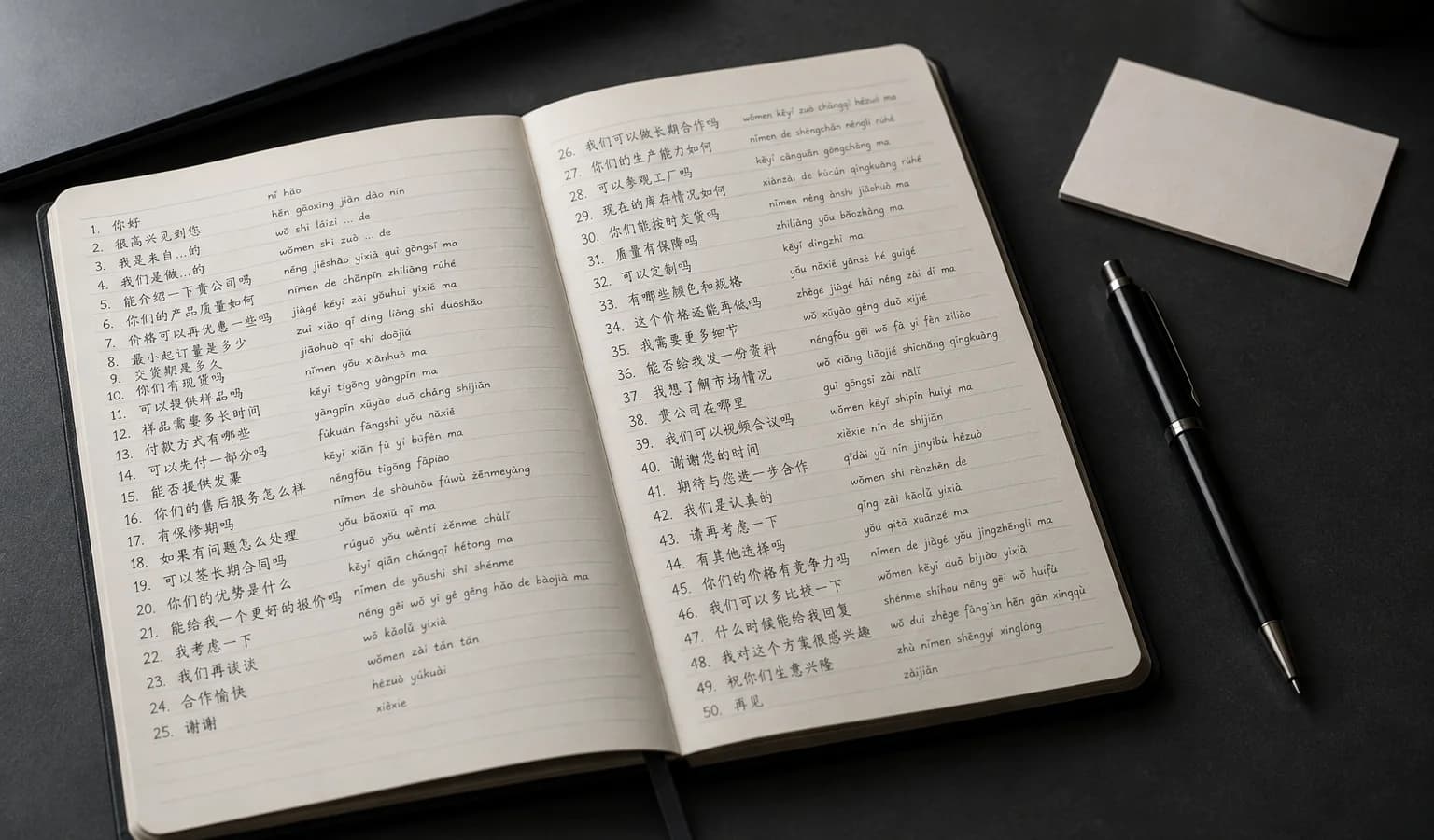
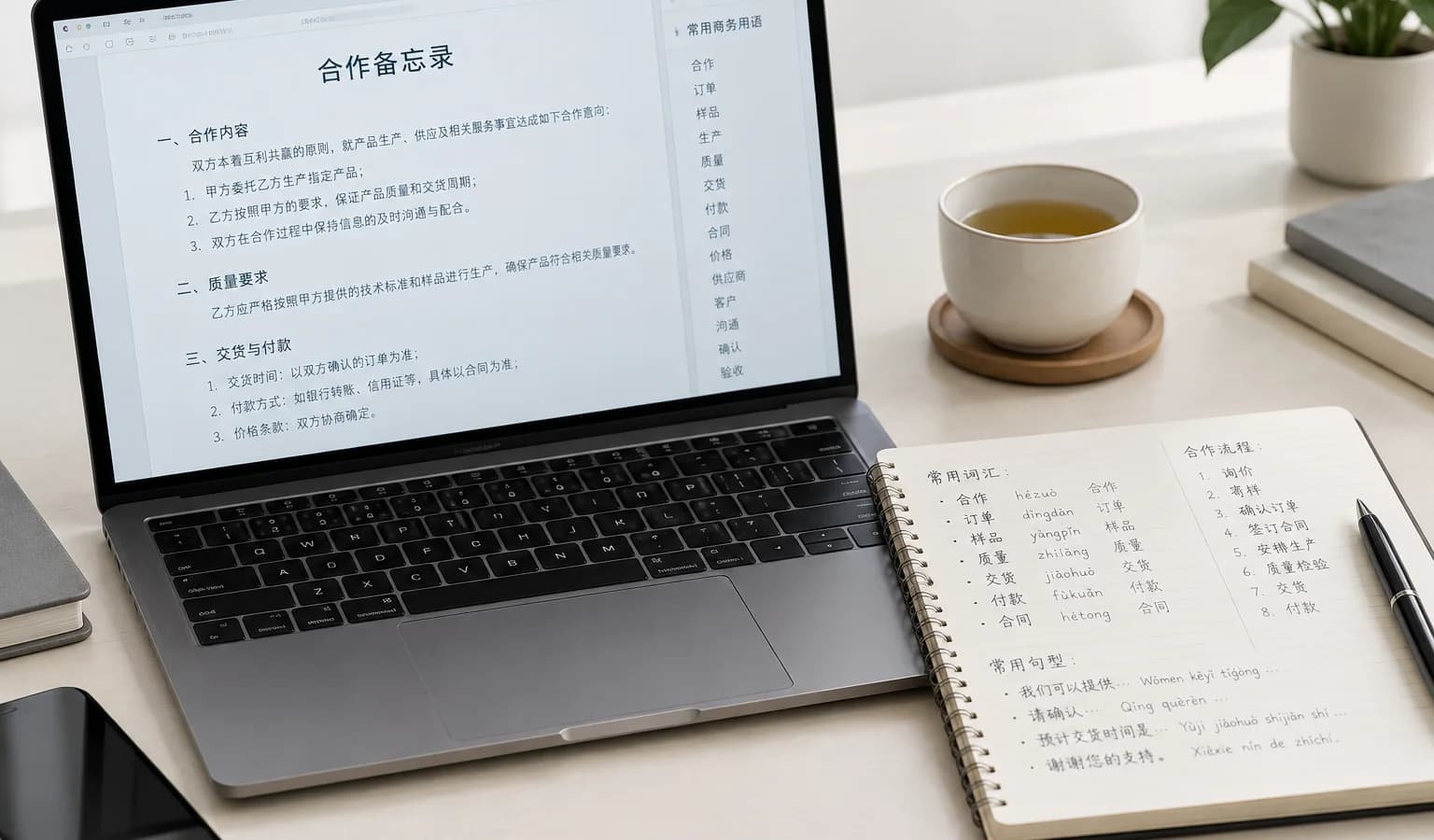
A working lexicon for those who order production in China: one hundred terms covering the stages of the cycle — from price and sample requests to inspection, packaging, and shipment. With 汉字, pinyin, and the meaning the word has in correspondence and on the factory floor, not in the dictionary.
 Mikhail Ansimov14 min read
The language of the factory is not the language of politeness. It is built around the specification: what material, what shape, what tolerance, what batch, when shipment. A person who has learned 你好 and 谢谢 but does not know 材质 (cáizhì, material) and 公差 (gōngchā, tolerance) remains speechless in correspondence with a supplier: he can say hello, but he cannot clarify what exactly they intend to produce for him.
Below are one hundred units, grouped not alphabetically and not by "general business" topics, but by the stages of real interaction with a factory. Each word is given with 汉字, pinyin, and its working meaning — the one it acquires in an email, in a specification, or on the factory floor. The dictionary meaning sometimes coincides with the working one, sometimes not, and it is precisely on this discrepancy that most misunderstandings arise.
This is not a phrasebook for a trip and not a list of phrases for negotiating price. It is a terminological base of the production cycle — including words that almost never appear in tourist collections but constantly appear in business correspondence: 唛头, 公差, 开模, 备货.
How to use this list
It is useful to distinguish three levels of mastery of a term. The first is recognizing it in an email: you see 起订量 and understand what is being discussed, even if you yourself do not write that way. The second is understanding it by ear: in a conversation at the factory, the term is spoken quickly and in a context that helps you guess. The third is using it yourself: you formulate a request so that the supplier understands you without asking again.
For most people working with China, the first and second levels are enough across the whole list, and the third — for their own product category. There is no need to learn all one hundred words for active use, and it is harmful: the active vocabulary becomes diluted if there is no practice in it.
The second warning is more important than the first. Some of these words have different meanings in everyday and in production contexts. 出货 (chūhuò) in conversation can mean "the goods have gone out," while in logistics it means a specific date of shipment from the factory warehouse. 发票 (fāpiào) in everyday life is a receipt; in business correspondence it is a tax document with legal consequences. If you transfer the everyday meaning into a production context, you will almost always understand it incorrectly.
Block 1. Inquiry and first contact
First contact with a factory is always a clarification of what you actually want and on what terms. Here it is important not to confuse who is in front of you: a plant or an intermediary.
- 工厂 (gōngchǎng) — plant, factory. The word denotes a production unit, not a trading company.
- 供应商 (gōngyìngshāng) — supplier. It can be either a factory or a trading company. In correspondence this distinction is often fundamental: a 供应商 without its own production has no access to the workshop, and all technical questions go through an intermediary.
- 询价 (xúnjià) — price inquiry. Your action: you ask.
- 报价 (bàojià) — price offer, quotation. The supplier's action: he replies.
- 起订量 (qǐdìngliàng) — minimum order quantity. In correspondence this word can mean two different things: the minimum batch to start production and the minimum batch for shipment. These meanings do not always coincide, and they need to be clarified separately.
- 最小起订量 (zuìxiǎo qǐdìngliàng) — minimum order in an explicit formulation. It is often used where 起订量 sounds ambiguous.
- 样品 (yàngpǐn) — sample.
- 打样 (dǎyàng) — making a sample. This is a process, not an item.
- 现货 (xiànhuò) — goods from stock, in stock. If the goods are 现货, the timelines are sharply reduced, but the choice by specification is usually already limited.
- 定制 (dìngzhì) — custom manufacturing, customization. The antonym of 现货.
- 规格 (guīgé) — specification, technical parameters.
- 型号 (xínghào) — model, article number.
- 材质 (cáizhì) — material. The word that should be clarified first: 材质 in the email and 材质 in the finished product sometimes diverge.
- 单价 (dānjià) — price per unit.
- 含税 (hánshuì) — with tax. 不含税 (bù hánshuì) — without tax. The difference in price between these two formulations can be significant, and it is not always obvious from the context.
Block 2. Production and materials
Here begins the technical part, where machine translation most often fails. English terms like "injection molding" or "tolerance" are translated into Chinese consistently, and these stable pairs are worth knowing.
- 塑料 (sùliào) — plastic.
- 五金 (wǔjīn) — metal hardware, "ironware" in the broad sense. In procurement this is a separate category of parts: screws, hinges, latches.
- 不锈钢 (bùxiùgāng) — stainless steel.
- 铝合金 (lǚhéjīn) — aluminum alloy.
- 注塑 (zhùsù) — injection molding.
- 冲压 (chōngyā) — stamping.
- 焊接 (hànjiē) — welding.
- 组装 (zǔzhuāng) — assembly.
- 表面处理 (biàomiàn chǔlǐ) — surface treatment. A general term that covers various processes.
- 电镀 (diàndù) — electroplating.
- 喷涂 (pēntú) — spray coating, spray painting.
- 模具 (mújù) — mold, die. An item.
- 开模 (kāimú) — making a mold. A process. The distinction is important: 模具 exists, 开模 happens.
- 模具费 (mújù fèi) — fee for making the mold. In some cases it is refunded upon reaching an agreed order volume, but this is not a universal practice, but a matter of agreement. The wording "usually refunded" would be inaccurate here.
- 公差 (gōngchā) — tolerance, technological dimensional deviation. A key word for understanding that "size 10 mm" at the factory means a range, not an absolute value.
- 尺寸 (chǐcùn) — size, dimensions.
- 厚度 (hòudù) — thickness.
- 重量 (zhòngliàng) — weight.
- 工艺 (gōngyì) — technology, technological process. It is often used where the method of manufacture as a whole is meant.
- 打样费 (dǎyàng fèi) — fee for making a sample. Like 模具费, it may be refunded upon ordering, but this is a separate agreement.
Block 3. Quality and control
The most sensitive part of the lexicon. Here there are two terms that are often confused and denote different stages of control.
- 质量 (zhìliàng) — quality.
- 质检 (zhìjiǎn) — quality control during production. This is not inspection of the finished batch, but checking at stages.
- 验货 (yànhuò) — inspection of the finished batch, often before shipment. A separate stage with its own protocol.
- 抽检 (chōujiǎn) — sampling inspection, by sample.
- 全检 (quánjiǎn) — full inspection, of every unit.
- 合格 (hégé) — meets the standard, has passed control.
- 不合格 (bù hégé) — does not meet the standard. The word often appears in reports, and behind it stands a specific defect rate.
- 次品 (cìpǐn) — defective item, second-grade goods.
- 瑕疵 (xiácī) — defect, flaw. A softer word than 次品: 瑕疵 can be cosmetic.
- 返工 (fǎngōng) — rework, redo.
- 报废 (bàofèi) — scrapping as defective, disposal of the irreparable.
- 标准 (biāozhǔn) — standard.
- 认证 (rènzhèng) — certification, certificate.
- 检测报告 (jiǎncè bàogào) — test report, inspection report.
- 质量问题 (zhìliàng wèntí) — quality problem. A formulation for a claim that sounds less confrontational than a direct accusation.
Block 4. Packaging and marking
Packaging is the stage where saving time turns into damaged cargo. Here there is a word that almost never appears in phrasebooks, but constantly appears in shipment correspondence.
- 包装 (bāozhuāng) — packaging.
- 内包装 (nèi bāozhuāng) — inner packaging.
- 外包装 (wài bāozhuāng) — outer packaging, transport packaging.
- 纸箱 (zhǐxiāng) — cardboard box.
- 木箱 (mùxiāng) — wooden crate. For heavy and fragile cargo.
- 托盘 (tuōpán) — pallet.
- 标签 (biāoqiān) — label.
- 唛头 (màitóu) — shipping mark, marking of cargo places. A term from foreign trade documentation; it is usually absent from phrasebooks, but it is almost always present in correspondence.
- 条码 (tiáomǎ) — barcode.
- 说明书 (shuōmíngshū) — instruction manual, guide.
- 中性包装 (zhōngxìng bāozhuāng) — neutral packaging, without a brand.
- 定制包装 (dìngzhì bāozhuāng) — custom packaging, with your design.
Block 5. Timelines and logistics
Here it is important to distinguish which exact moment is meant: the readiness of the goods, the departure from the factory warehouse, or arrival at the destination port.
- 交期 (jiāoqī) — delivery deadline, order fulfillment deadline. A general term.
- 交货 (jiāohuò) — the delivery of the goods itself, the handover.
- 交货期 (jiāohuò qī) — the deadline for handing over the goods. Close to 交期, but with emphasis on the moment of handover.
- 生产周期 (shēngchǎn zhōuqī) — production cycle. The period from launch to readiness, not including logistics.
- 备货 (bèihuò) — preparation of the goods, assembly of the batch. The stage between production and shipment.
- 出货 (chūhuò) — shipment on the factory's side.
- 发货 (fāhuò) — dispatch. It can refer both to the factory and to the carrier.
- 到货 (dàohuò) — arrival of the goods.
- 海运 (hǎiyùn) — sea freight.
- 空运 (kōngyùn) — air freight.
- 快递 (kuàidì) — courier delivery, express.
- 拼柜 (pīnguì) — consolidated cargo, LCL. Literally "shared container."
- 整柜 (zhěngguì) — dedicated container, FCL.
- 报关 (bàoguān) — customs clearance for export.
- 清关 (qīngguān) — customs clearance for import.
- 提单 (tídān) — bill of lading.
Block 6. Money and documents
The financial part of correspondence requires particular precision, because here a mistake in a term has direct monetary consequences.
- 定金 (dìngjīn) — deposit, down payment. Usually part of the sum in advance to start production.
- 尾款 (wěikuǎn) — balance payment. Paid after readiness or shipment.
- 预付款 (yùfùkuǎn) — prepayment. A more general term than 定金.
- 付款方式 (fùkuǎn fāngshì) — method of payment.
- 电汇 (diànhuì) — bank transfer, T/T.
- 信用证 (xìn yòngzhèng) — letter of credit, L/C.
- 发票 (fāpiào) — in the Chinese context this is an official tax document, not a full equivalent of the Western invoice. Its functions and legal status differ; for practical purposes it is enough to remember that they are not the same thing.
- 增值税发票 (zēngzhíshuì fāpiào) — VAT invoice. A separate type of document with tax consequences.
- 合同 (hétóng) — contract, agreement.
- 条款 (tiáokuǎn) — term, clause of a contract.
- 违约 (wéiyuē) — breach of contract.
- 索赔 (suǒpéi) — claim, demand for compensation.
- 汇率 (huìlǜ) — exchange rate. In correspondence it can affect the final price if it is denominated in a currency.
Block 7. Communication during the process
These words do not describe production, but they manage it. The tone of an email is often more important than its content, and here there are several traps.
- 确认 (quèrèn) — to confirm, confirmation. A word that in correspondence can mean both "noted" and "agreed." The distinction is determined by context.
- 核实 (héshí) — to verify, to clarify a fact.
- 反馈 (fǎnkuì) — feedback, response.
- 跟进 (gēnjìn) — to follow up, to carry forward. A word for a polite reminder.
- 催货 (cuīhuò) — to rush the delivery. A direct word, and in an email it sounds like pressure. It should be formulated carefully.
- 延期 (yánqī) — postponement of the deadline, delay.
- 加急 (jiājí) — urgent, expedited. Usually implies an additional payment.
- 协调 (xiétiáo) — to coordinate, to align.
- 沟通 (gōutōng) — to communicate, communication.
- 误会 (wùhuì) — misunderstanding. A useful word for a soft exit from a conflict: calling a problem 误会 is less confrontational than calling it a mistake.
Practice: how to assemble a working minimum for your category
One hundred words is the whole landscape, but not your personal vocabulary. For a specific niche, thirty to forty units from the list are enough to cover most correspondence: your own category of materials, your own processes, your own types of packaging, your own documents. The rest is learned as needed.
A reasonable order is this: first you master the words of the first block — they are needed in any conversation. Then you add the terms of your category from the second and third blocks. Then — packaging and logistics, if you organize delivery yourself. Money and documents should be known by everyone, because here a mistake costs the most.
It is useful to keep your own glossary for your category: write out the terms that actually appear in your correspondence and record their translation in the meaning in which your supplier uses them. Different factories may mean slightly different things by the same words, and your glossary is not a dictionary but a working tool.
Typical mistakes of Russian speakers when working with this vocabulary
The first mistake is a calque from English. The term "tolerance" is translated as 公差, but the Russian "tolerantnost" leads you astray; "mold fee" is 模具费, not "payment for mold." Machine translation of technical terms is especially unreliable here, because one English word can correspond to several Chinese ones with different nuances.
The second is confusing 工厂 and 供应商. If you think you are talking to a factory but in fact you are talking to a trading company, you may be discussing technical details with a person who does not control them himself.
The third is perceiving 好的 (hǎo de) as agreement with the terms. In correspondence this word often means "noted, heard," not "agreed." The difference becomes visible later, when it turns out that the terms were not agreed.
The fourth is ignoring 唛头 and 公差. Both words look secondary, but they are precisely what determine whether the cargo arrives where it should and whether a part will fit another part.
What to do next
It is better to check an unfamiliar word not in a dictionary but in context: look at how the supplier uses it in other emails and clarify the meaning directly. The question "这个是什么意思?" (zhège shì shénme yìsi — what does this mean?) sounds normal in work correspondence and does not betray incompetence.
And lastly: agreed terms should be recorded in the contract itself or in an annex to it. If you have agreed on 公差, on 材质, on 唛头, these parameters should be in the document, not only in the correspondence. The language of the factory is the language of the specification, and the specification lives in the contract.
FAQ
Is English enough when working with a factory?
At many factories English is enough for basic correspondence: export managers work with foreigners for years. But technical details — tolerances, materials, processes — are often discussed more precisely in Chinese, and some terms have no established English equivalent at all. Knowing the key words reduces the risk of misunderstanding, even if you do not speak Chinese fluently.
How does 验货 differ from 质检?
验货 is inspection of the finished batch, often before shipment. 质检 is quality control during production, at stages. They are not synonyms: one term describes the final check, the other ongoing control. If you are ordering an inspection, clarify which stage is meant.
Why can 发票 not simply be translated as "invoice"?
In the Chinese context, 发票 is an official tax document with legal consequences, not a full equivalent of the Western invoice. Its functions and status differ. For practical purposes it is enough to remember that they are not the same thing and not to build financial expectations on that assumption.
What does 模具费 mean, and is it refunded?
模具费 is the fee for making the mold. In some cases it is refunded upon reaching an agreed order volume, but this is not a universal practice, but a matter of separate agreement. The wording "usually refunded" would be inaccurate: the terms depend on the specific factory and product category.
Is it possible to learn only 30 words and work?
For a specific niche — often yes. Thirty to forty terms from this list, selected for your category, cover most correspondence. The remaining words are learned as needed. What matters is not the quantity, but that your active vocabulary corresponds to your real tasks.
- #китайский язык
- #деловой китайский
- #работа с фабриками
- #термины производства
- #закупки в Китае
- #производственная лексика