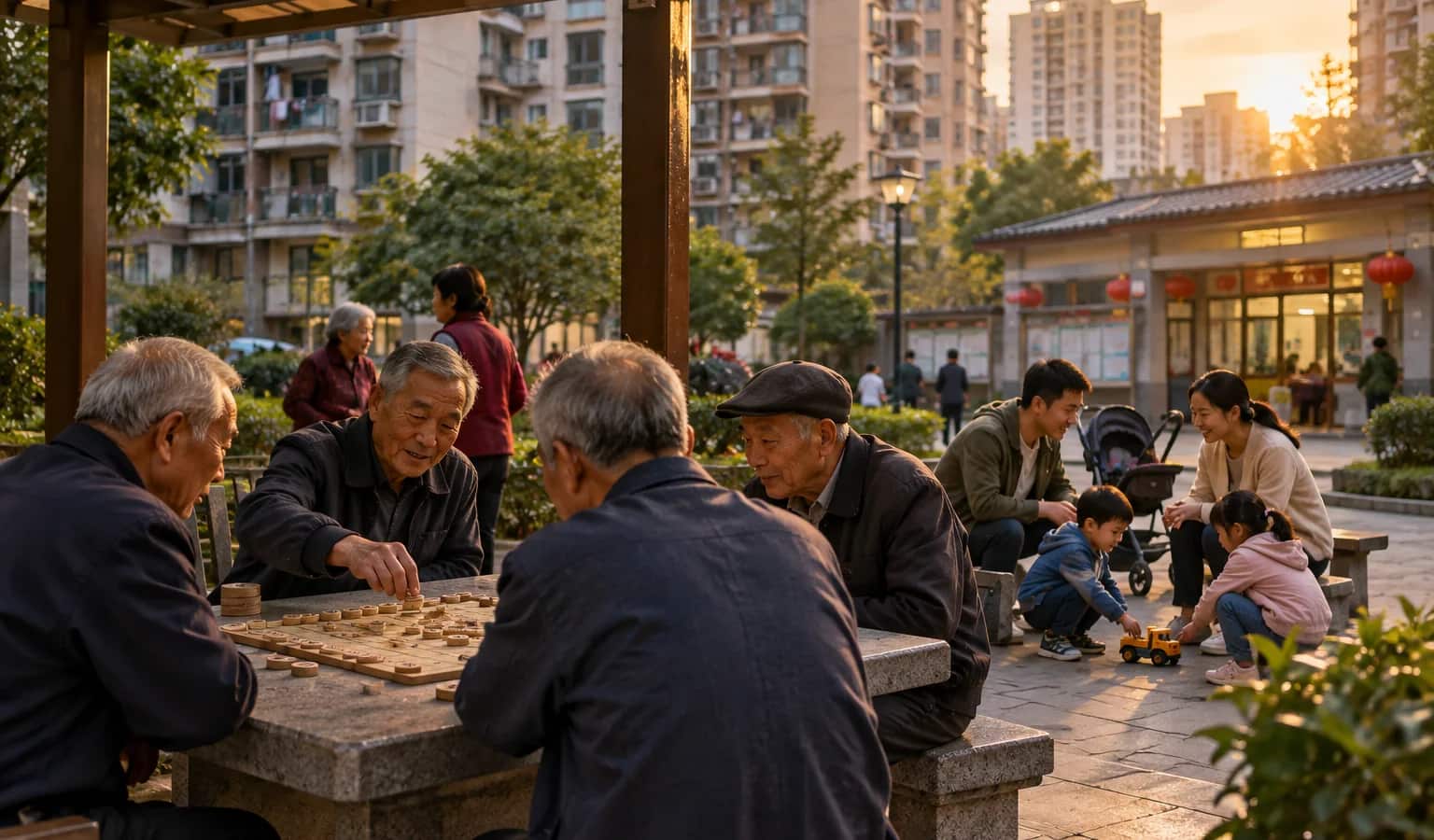

The question "why do Chinese people behave so differently at home, at work, and in society" usually implies a reproach: so they are insincere, they wear masks, they play roles. This is the wrong starting point. What is at issue is not a substitution of the true face but a switching between different sets of social obligations. In each environment — family, work organization, public space — what is considered polite, permissible, and obligatory changes. A person does not become someone else; he follows different rules.
Below I examine how this mechanism works and why a Western observer often sees a contradiction in it. Let me immediately set the boundaries: what follows is about culturally encouraged norms, not about the behavior of every Chinese person. Region, generation, industry, and the specific family can greatly change the picture. Where this matters, I note it.
Three Environments — Three Sets of Rules
Home, work, and public space differ not only in setting but also in the type of obligations. At home a person deals with close ones to whom he owes long-term, almost unconditional obligations. At work — with a hierarchy and an organization where role, status, and results matter. In society — with strangers to whom he is connected by almost nothing, but whose presence creates a public context.
What changes from environment to environment:
- the degree of directness — how permissible it is to say "no" or criticize;
- the expression of emotions — where one may raise one's voice and where this is perceived as a loss of control;
- who is considered "one of us" and who is "an outsider" — and what obligations this imposes;
- whose opinion matters — only relatives, colleagues, superiors, or random witnesses.
These are not three different people but three modes of one social navigation. Switching between them often happens automatically, without reflection — roughly the same way a person changes tone of speech when talking to a child and to a boss.
内外 (nèi/wài): The Logic of "Insiders" and "Outsiders"
The key to understanding is the distinction 内外 (nèi wài), literally "inner and outer." This is not a geographical division but a boundary of obligations. "Insiders" (内) are those to whom a person has a debt: family, close friends, sometimes long-time colleagues. "Outsiders" (外) are everyone else, including strangers and new acquaintances.
Different standards of politeness apply to "insiders" and "outsiders." With close ones, directness is permissible that from the outside looks rude: relatives may sharply criticize each other without considering it a conflict. With "outsiders," on the contrary, it is more important to preserve outward smoothness and not create awkwardness. This is not hostility toward strangers and not double morality — it is a different degree of obligations.
It is important not to confuse 内外 with closedness. A foreigner whom a Chinese partner has invited home for dinner may be perceived as having symbolically moved from the category 外 to 内 — but this is more a possible interpretation than a rule. The boundary is mobile, depends on trust, and does not always coincide with formal signs of closeness.
面子 (miànzi) and 脸 (liǎn) in Different Environments
The concepts 面子 (miànzi) and 脸 (liǎn) are often translated by the single word "face," but they are different things. 脸 is closer to moral reputation, to "how a person looks in the eyes of others" from the standpoint of dignity. 面子 is more a social credit, a public status that can be given, lost, or preserved. They should not be used as synonyms.
"Face" works differently in different environments. At home, the object of concern may be the family's face before relatives or neighbors. At work — hierarchical face: a superior must not lose face before subordinates, a subordinate — before colleagues. In society — face before strangers who will most likely never be met again, but whose presence makes a conflict public.
A public conflict is more costly than a domestic one precisely because people are watching. A quarrel in the family remains within the circle of "insiders"; a quarrel in the subway or in a meeting room with witnesses touches the 面子 of several people at once. Hence the increased restraint in society and at work — not because a person is less sincere, but because the stakes are higher.
人情 (rénqíng) and 关系 (guānxi): The Debt of Reciprocity in Different Environments
At home and at work, mutual obligations are structured differently. At home, 人情 (rénqíng) — the sense of duty and reciprocity — according to a widespread view is closer to unconditional: parents care for children not in expectation of immediate return, although in the long term children's care for parents is expected. At work, 人情 turns into a more measurable exchange: a service, a favor, a recommendation create a debt that sooner or later must be repaid.
关系 (guānxi) is not simply "connections" and not simply "relationships." It is a network of mutual obligations where each contact implies certain expectations. At home, 关系 rests on kinship and a long history; at work — on joint activity, hierarchy, and reputation. Therefore the same person can be generous and open in the family and cautious, calculating in business relationships — not out of hypocrisy, but because these are different types of debt.
This is directly connected to trust, but not identical to it. Trust in the Chinese context is often built through personal acquaintance and the test of time, not through a formal contract. However, this topic deserves a separate discussion; what matters here is only that at home and at work, trust and obligations have a different nature.
场合 (chǎnghé): Situation as a Switch
The concept 场合 (chǎnghé) — "situation," "occasion," "setting" — explains why the same person at a meeting, in a restaurant with partners, and at home behaves incomparably differently. 场合 sets not only formal rules but also the expected "form" of behavior: what is appropriate, what is not, what role must be played.
At a business dinner with partners, a person may be emphatically polite, drink a lot, make toasts, and avoid sensitive topics. The next morning in the meeting room he may be tough and direct on the same issues. This is not a contradiction: the evening 场合 required maintaining relationships, the morning one — defending interests. A change of context changes not the goals but the permissible means.
It is useful for a foreigner to ask himself: what is the 场合 right now? Who is the audience? What is considered appropriate here? This is not a justification for any behavior, but it helps not to mistake a change of mode for deception.
Why the Western Observer Sees a Contradiction
The Western cultural norm often presupposes a "single personality": a person must be consistent, the same in different circumstances, and a change of behavior is perceived as insincerity. Chinese logic is more situational: what matters is appropriateness in a specific context, not abstract unchangingness.
This creates real problems for a foreigner. A partner who was warm and open yesterday but today at negotiations is cold and formal may seem two-faced. A colleague who sharply criticizes his family over lunch may look callous. In fact, what changes is not the attitude toward you but the mode of interaction.
The mistake is to transfer the expectations of one environment to another. If a Chinese partner has invited you home, this does not mean that at work he will make concessions. If he bargains toughly, this does not mean that he personally does not respect you.
Generations, Region, Industry: Where the Model Breaks Down
The described model is a tendency, not a universal law. It is more noticeable in some segments and weaker in others.
- Cities and small towns: in megacities with high mobility and a mixed population, the boundaries of 内外 are often more mobile; in small towns and rural areas, kinship and neighborly ties are denser and norms stricter.
- Generations: the younger generation, which grew up in the era of the internet and market competition, may be more direct and less concerned with preserving 面子 in the traditional sense; the older generation — the opposite.
- Industries: in state structures and large traditional companies, hierarchy and ritual are stronger; in startups and international teams, behavior may be closer to Western.
- Mixed families and expats: in families where one spouse is a foreigner, norms are often revised, and the "home" mode may become more direct or, conversely, more cautious.
Therefore any generalizations about "Chinese people" should be taken as a description of a cultural tendency, not as a characterization of a specific person.
What This Gives in Practice
Understanding the switching of modes helps in several situations.
In negotiations: if a partner was soft at dinner and became tough at the negotiating table, do not rush to consider this a personal attack. Most likely, the 场合 changed, and with it the permissible directness and role.
In everyday life: the public restraint of Chinese people in the subway or on the street does not mean coldness. It is background, not an attitude toward you personally. In the same way, "home" directness is not automatically transferred to work communication: what is permissible with relatives may be inappropriate with colleagues.
In long-term relationships: the transition from 外 to 内 is a process, not an event. An invitation home, participation in a family holiday, willingness to discuss personal topics are signs of movement in this direction. But there is no automatic reverse: while remaining "an insider" in a personal circle, you may remain "an outsider" in business.
FAQ
Is this hypocrisy?
No, if hypocrisy is understood as conscious deception. What is at issue is following different social norms in different environments. A person can be sincere both at home and at work, but express it differently because the obligations and the audience are different.
Does behavior change in mixed marriages?
Often yes, but in different ways. In mixed families, norms are frequently revised: some couples become more direct, others, on the contrary, more cautious in order to avoid misunderstandings. Much depends on the specific people and their environment.
How should a foreigner behave in each of the three environments?
At home: be attentive to signs of acceptance, do not force closeness, but also do not refuse invitations. At work: observe hierarchy, do not criticize publicly, clarify expectations. In society: observe distance and do not perceive restraint as personal dislike.
Does this mean that Chinese people are always restrained in society?
No. In a crowd, in a queue, on public transport, one can encounter both loud conversations and emotional reactions. Restraint is a tendency, not a rule without exceptions. It is stronger in situations where 面子 is at stake and weaker in anonymous or familiar contexts.
Conclusion
Different behavior at home, at work, and in society is not a split personality and not double standards but a social grammar. It sets what degree of directness, what emotionality, and what obligations are appropriate in each context. Understanding this grammar does not justify everything, but it helps to read situations more accurately and not to mistake a change of mode for deception. For a foreigner this is a practical skill: to ask oneself what the 场合 is right now, who are "insiders" and who are "outsiders," and whose 面子 may be affected. Such an approach reduces the number of false interpretations and facilitates both business and everyday communication.