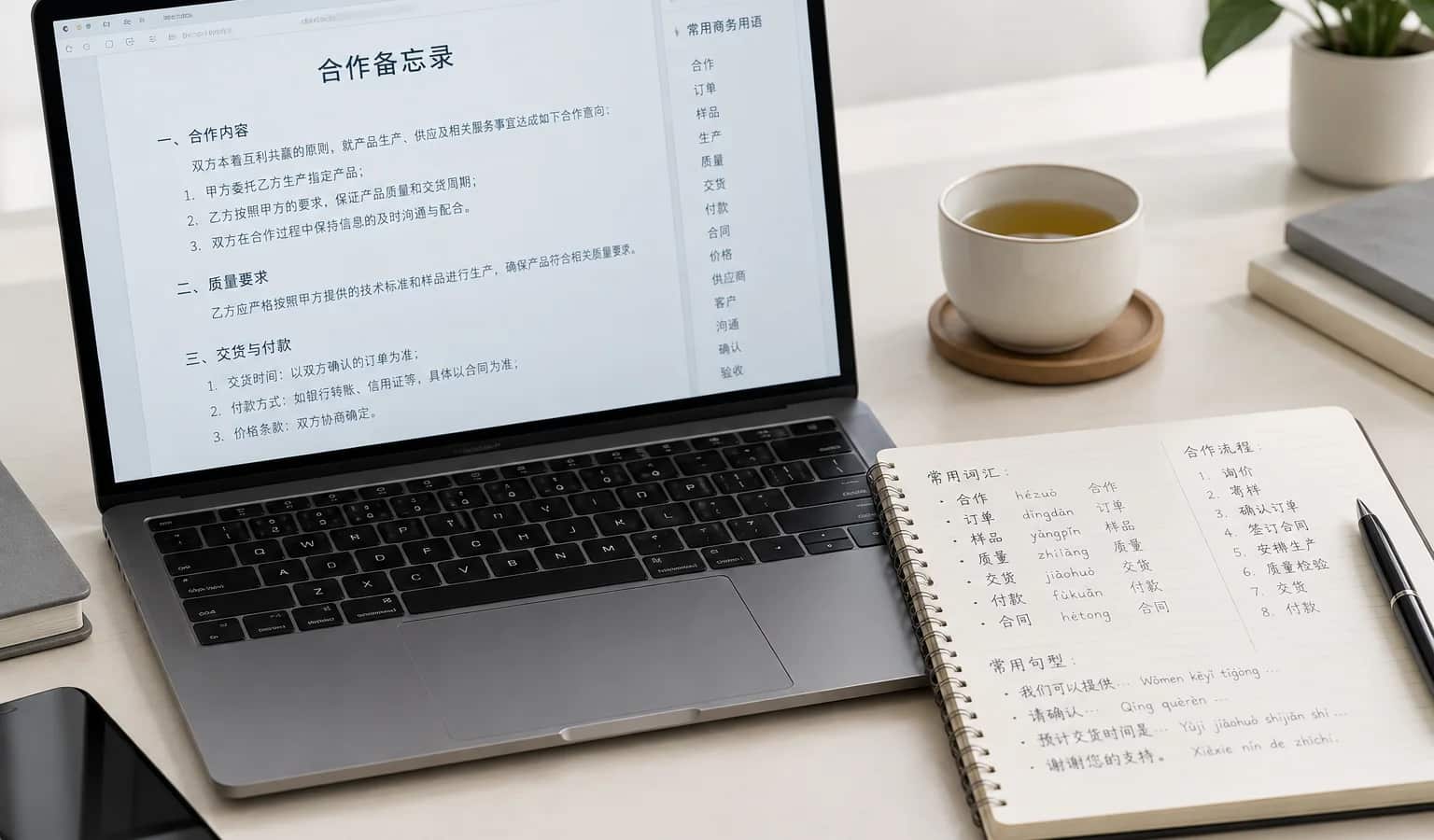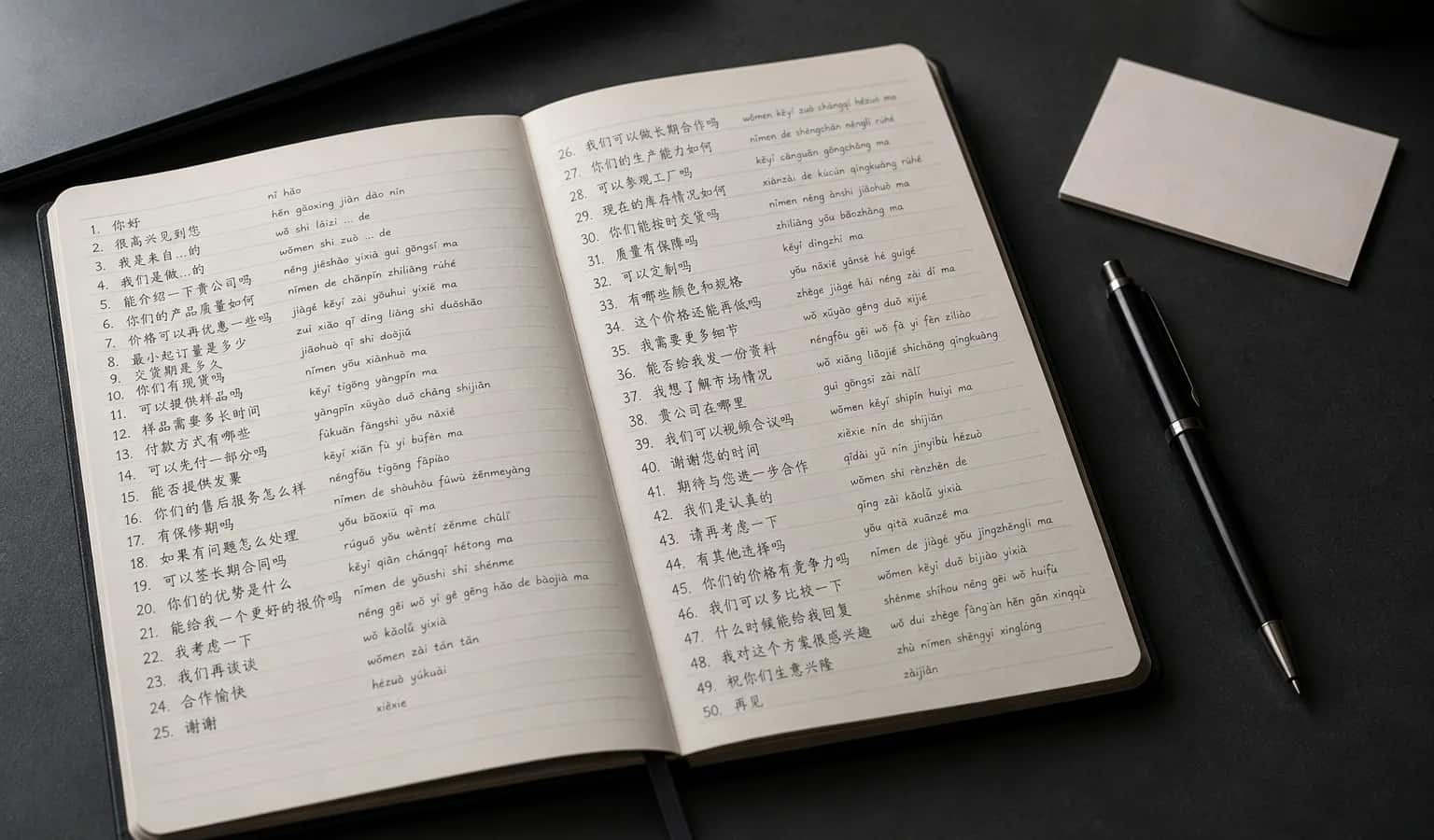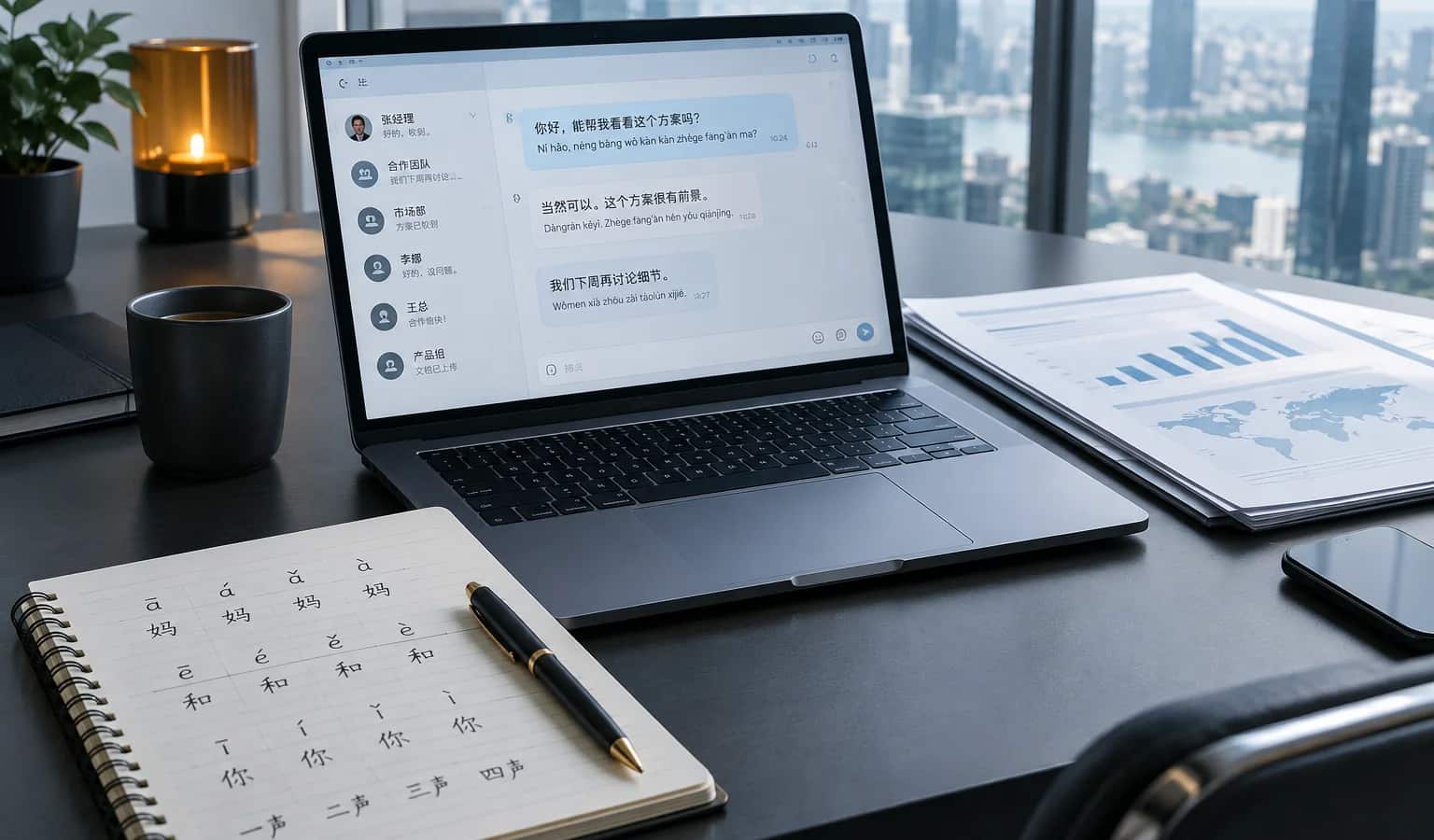

A factory visit in China is not a tour and not a social call. It is a short working conversation in conditions where it is noisy, where you are taken along a route, and where each side has its own goal. English is often enough on such a visit, but not always: in the workshop, the person talking to you is not the export manager but an engineer or a section supervisor, and it is they who determine the answer to the question that really interests you. Below are 30 phrases grouped by stages of the visit. This is not a list to memorize, but a set of moves: each phrase either removes the risk of misunderstanding or opens a topic that is usually not raised on the run.
Why even use Chinese at a factory if there is English
At a Canton Fair booth, English is usually enough: export managers work there, with ready catalogues and price lists. A factory is a different environment. The export manager who handled your correspondence may be absent or busy, and in the workshop you are accompanied by a person whose job is production, not communication with foreigners. In this situation, a few Chinese phrases do two things: they show that you did not come as a tourist, and they give you the opportunity to ask a question directly, without waiting for someone to translate.
The second effect is less obvious but important. A Chinese phrase at a factory often works not as a transfer of information but as a social move: it softens pressure, requests clarification or closes a topic without moving to a direct refusal. This is the same logic as in negotiations with a supplier: literal translation and negotiation effect are different things. That is why in the phrasebook below, each phrase includes not only its meaning but also what it does in the conversation.
Another note on boundaries. The level of English at factories varies by region, industry and company size: in Guangdong and Zhejiang, where export work has been done for decades, there is a greater chance of English than in the interior of the country. But this is a tendency, not a rule, and it cannot be relied on when planning a visit. The Chinese in this phrasebook is not a replacement for English, but insurance for when English is not enough.
How a factory visit is structured: the logic of the stages
A visit to a production facility usually follows a predictable scenario. First — a meeting at the entrance or in the meeting room, exchanging business cards, introducing the team. Then — registration and a pass, because outsiders are not allowed onto the premises without paperwork. Next — the workshop tour: you are taken along a route, shown sections, sometimes stopped at a specific line. After the workshop — a conversation about what you saw: equipment, capacity, samples, quality. And at the end — discussion of deadlines, volume and the next step.
This logic is important because the phrases are tied to stages, not to topics. At the entrance it is pointless to ask about line capacity, and in the workshop it is awkward to discuss price. The phrasebook below follows this order so that you can open the needed section before the corresponding stage, rather than searching for a phrase throughout the text.
Greeting, exchanging business cards, introducing the team
The first minutes of the visit set the tone. Simple formulas of politeness work here, and the main thing is not to mix up whom you are addressing. In the Chinese business environment, it is customary to address a person by surname with the addition of a position or the neutral 先生 (xiānsheng, "Mr.") and 女士 (nǚshì, "Ms.").
- 您好,我是……公司的…… (nín hǎo, wǒ shì … gōngsī de …) — "Hello, I am … from company …". A basic formula of introduction. 您 (nín) — polite "you", appropriate on first contact.
- 很高兴见到您。 (hěn gāoxìng jiàndào nín) — "Very glad to see you". A standard formula, requires no creativity.
- 这是我的名片。 (zhè shì wǒ de míngpiàn) — "Here is my business card". A business card is customarily given and received with both hands or the right hand, with the text turned toward the other person.
- 这位是我们的工程师。 (zhè wèi shì wǒmen de gōngchéngshī) — "This is our engineer". Useful if you came with a technical specialist: by indicating the role, you let the Chinese side understand who to talk to about technical details.
- 请问怎么称呼您? (qǐngwèn zěnme chēnghu nín) — "How should I address you?" A polite way to clarify surname and position without guessing.
The practical meaning of this stage is simple: if you immediately indicate who in your team is responsible for what, the conversation will go faster afterward. The Chinese side, as a rule, will also introduce its team, and you will understand who among those present makes decisions and who is simply accompanying.
Entering the premises and navigation: registration, pass, escort
At many factories, entering the premises requires registration: security records visitors, and sometimes a document is requested. This is not distrust of you personally, but ordinary procedure. Here, phrases are useful that show you understand the procedure and are not trying to bypass it.
- 我们需要登记吗? (wǒmen xūyào dēngjì ma) — "Do we need to register?" A neutral question, it removes awkwardness at the entrance.
- 我可以拍照吗? (wǒ kěyǐ pāizhào ma) — "May I take photos?" In production, photos are often restricted, and it is better to ask in advance than to get a reprimand in the workshop.
- 请带我们参观一下。 (qǐng dài wǒmen cānguān yíxià) — "Please show us around the premises". A formula that shifts the visit into tour mode.
- 这边请。 (zhèbiān qǐng) — "This way, please". This phrase is more often said by the escort, but it is useful to understand it: you will be directed exactly like this.
- 请问洗手间在哪里? (qǐngwèn xǐshǒujiān zài nǎlǐ) — "Where is the restroom, excuse me?" An everyday question that always arises on a large premises.
Separately, it is worth remembering safety. Access rules in the workshop depend on the industry: in some places helmets and safety glasses are required, in others — shoe covers and a coat. There is no universal rule, and if you are given protective equipment, it is not a formality but a production requirement. If you do not understand what you are being told, it is better to ask than to nod and walk on.
Workshop tour: requests to show, explain, stop
The workshop is noisy, and this changes communication. Phrases should be short, and questions specific. The main task at this stage is not to lose control of the route: you are taken along a path convenient for the factory, but you need to see what is important to you.
- 可以看一下这条生产线吗? (kěyǐ kàn yíxià zhè tiáo shēngchǎnxiàn ma) — "May I look at this line?" 生产线 (shēngchǎnxiàn) — "production line", a key word in the workshop.
- 这个工序是做什么的? (zhège gōngxù shì zuò shénme de) — "What does this stage do?" 工序 (gōngxù) — "operation, processing stage". The question helps to understand where in the process a risk to quality arises.
- 请慢一点,我想看一下。 (qǐng màn yìdiǎn, wǒ xiǎng kàn yíxià) — "Slower, please, I want to look". A polite request to stop that does not look like a complaint.
- 这里可以停一下吗? (zhèlǐ kěyǐ tíng yíxià ma) — "Can we stop here?" A more direct request, appropriate when you see a problem area.
- 我明白,请继续。 (wǒ míngbai, qǐng jìxù) — "Understood, continue". A phrase that maintains the pace of the tour and shows that you are following the explanation.
There is a subtlety here. If you want to see an area that is not being shown to you, a direct question like "why are you hiding this" will almost certainly close the topic. A soft request to look at a specific line works better: it does not put the escort in the position of someone who refuses, and leaves them the opportunity to fulfill the request without losing face. This is the same logic as in negotiations: an indirect request is often more effective than a direct demand.
Questions about the line, equipment and capacity
This is the core of the technical part of the visit. Here it is important to distinguish what you are being told: line capacity, actual load and deadlines are different things, and on site they are easy to confuse. The phrases below help separate these topics.
- 这台设备是什么品牌的? (zhè tái shèbèi shì shénme pǐnpái de) — "What brand is this equipment?" 设备 (shèbèi) — "equipment", 品牌 (pǐnpái) — "brand".
- 这条线一天能生产多少? (zhè tiáo xiàn yì tiān néng shēngchǎn duōshao) — "How much does this line produce per day?" A question about capacity, not about your order.
- 现在这条线在做什么产品? (xiànzài zhè tiáo xiàn zài zuò shénme chǎnpǐn) — "What is this line producing now?" Allows you to understand whether the line is working on another order and how loaded it is.
- 这个产品是我们订单的吗? (zhège chǎnpǐn shì wǒmen dìngdān de ma) — "Is this product for our order?" A direct check, but formulated as a clarification, not as an accusation.
- 可以看一下检测报告吗? (kěyǐ kàn yíxià jiǎncè bàogào ma) — "May I look at the test report?" 检测 (jiǎncè) — "inspection, testing". On site this question is more appropriate than in correspondence: the document can be viewed immediately.
Caution is needed here in one thing: the capacity figures quoted to you on site are, as a rule, an estimate, not a commitment. The actual deadline and volume depend on current load, material availability and the season. Therefore, it is useful to clarify the answer to the capacity question separately, already in the conversation about deadlines.
Samples, materials and specification
The conversation about samples at a factory is more concrete than in correspondence: you can take the item in your hands, compare it with what you ordered, and ask a question immediately. Here, phrases work that record an agreement, not merely describe a wish.
- 可以给我一个样品吗? (kěyǐ gěi wǒ yí gè yàngpǐn ma) — "May I have a sample?" 样品 (yàngpǐn) — "sample".
- 这个材料和上次的不一样。 (zhège cáiliào hé shàngcì de bù yíyàng) — "This material is different from last time". A statement, not a complaint; it gives the interlocutor a chance to explain.
- 规格和订单一致吗? (guīgé hé dìngdān yízhì ma) — "Does the specification match the order?" 规格 (guīgé) — "specification, parameters".
- 这个颜色可以调整吗? (zhège yánsè kěyǐ tiáozhěng ma) — "Can this color be adjusted?" A question about production flexibility, not about a ready solution.
- 样品什么时候可以寄出? (yàngpǐn shénme shíhou kěyǐ jì chū) — "When can the sample be sent?" Moves the conversation to the next step without requiring an immediate answer on price.
The practical value of this stage is that on site it is easier to notice a discrepancy than from a photo. If you see that the material or shade differs from what is expected, it is better to record this immediately and ask for a sample to take with you: later, in correspondence, a dispute about color is almost impossible to resolve.
Quality and control: what to ask on site
Questions about quality at a factory make sense only when they are tied to a specific production stage. General words like "is your quality good?" do not work. What works are questions about who checks the products and how.
- 谁来负责质量检查? (shuí lái fùzé zhìliàng jiǎnchá) — "Who is responsible for quality inspection?" 质量 (zhìliàng) — "quality", 检查 (jiǎnchá) — "inspection".
- 每个环节都检查吗? (měi gè huánjié dōu jiǎnchá ma) — "Is every stage checked?" 环节 (huánjié) — "link, stage of the process".
- 如果发现问题,怎么处理? (rúguǒ fāxiàn wèntí, zěnme chǔlǐ) — "If a problem is found, how is it handled?" A question about procedure, not about blame.
- 可以看一下不良品区吗? (kěyǐ kàn yíxià bùliángpǐn qū ma) — "May I look at the defective goods area?" 不良品 (bùliángpǐn) — "nonconforming products". Not every factory will readily show this, but the question itself says a lot about the process.
- 这个标准是客户要求的吗? (zhège biāozhǔn shì kèhù yāoqiú de ma) — "Is this standard a customer requirement?" Helps to understand whether the factory works to your standard or to its own internal one.
The point of these questions is not to catch the factory in a mistake. The point is to understand how control is structured: is there a separate person responsible for quality, or is inspection distributed among operators. This determines how predictable the result of your order will be.
Deadlines, volume and terms: cautious wording
A conversation about deadlines and volume on site is useful, but its result is a guideline, not an agreement. At the factory you speak with production people, while the terms of the deal are usually confirmed by the export manager in correspondence. Therefore, the phrases here should be cautious: they request an estimate, not record a commitment.
- 大概需要多长时间? (dàgài xūyào duō cháng shíjiān) — "About how long will it take?" 大概 (dàgài) — "approximately, about". The word is important: it shows that you understand the estimate is approximate.
- 这个数量可以接受吗? (zhège shùliàng kěyǐ jiēshòu ma) — "Is this quantity acceptable?" 数量 (shùliàng) — "quantity". A question about possibility, not about agreement.
- 可以分批发货吗? (kěyǐ fēnpī fāhuò ma) — "Can you ship in batches?" 分批 (fēnpī) — "in batches", 发货 (fāhuò) — "shipment".
- 如果加急,可以提前吗? (rúguǒ jiājí, kěyǐ tíqián ma) — "If it is urgent, can it be earlier?" 加急 (jiājí) — "urgent order". A question about an option, not a demand.
- 我们回去再确认一下。 (wǒmen huíqù zài quèrèn yíxià) — "We will go back and confirm". A formula that closes the topic without making a promise. In Chinese communication, the direct formula "we will think about it" often works exactly like this: it is not a refusal, but it is not agreement either.
Here it is worth remembering the difference between 工厂 (gōngchǎng, "factory") and 供应商 (gōngyìngshāng, "supplier"). These are different roles with different responsibilities: the factory is responsible for production, while the supplier may be an intermediary. If you are negotiating with an intermediary, the deadlines and volume quoted at the factory may differ from what is confirmed to you in the contract.
Ending the visit and agreeing on the next step
The finale of the visit is often more important than it seems. If you leave without a clear next step, the visit remains a pleasant impression but does not move the deal forward. Here, phrases are needed that record who does what next.
- 谢谢你们的接待。 (xièxie nǐmen de jiēdài) — "Thank you for the reception". 接待 (jiēdài) — "reception, hosting guests".
- 我们保持联系。 (wǒmen bǎochí liánxì) — "We will keep in touch". A neutral formula, appropriate at the end of the visit.
- 我回去后会发邮件确认。 (wǒ huíqù hòu huì fā yóujiàn quèrèn) — "After returning, I will send an email to confirm". Indicates a specific action on your side.
- 可以加一下微信吗? (kěyǐ jiā yíxià Wēixìn ma) — "May I add you on WeChat?" In China's business environment, WeChat is often more convenient than email for quick questions.
- 期待下次合作。 (qīdài xià cì hézuò) — "Looking forward to cooperating next time". A polite ending that creates no obligations.
The practical meaning of this stage is not to leave the conversation in limbo. Even if a decision has not yet been made, a concrete action — an email, a sample, adding on WeChat — moves the visit to the next stage.
Typical mistakes in speech and tone
Mistakes at a factory are rarely related to grammar. More often they are related to tone and to the role you assign yourself. Below are several typical situations.
Too direct criticism. The phrase "this is poor quality" on site will almost certainly provoke a defensive reaction. A soft statement — "this material is different from last time" — leaves the interlocutor the opportunity to explain and correct without losing face. This is not about politeness for politeness's sake: face (面子, miànzi) here works as social credit that is measured publicly, and a public remark in the workshop is perceived differently from the same remark in correspondence.
A direct "no" in response to a proposal. In Chinese communication, a direct "no" is often replaced by an indirect refusal, and your sharp "does not suit us" may close a topic you wanted to discuss. The formula "we will go back and clarify" leaves the conversation open.
Ignoring procedures. An attempt to enter the workshop without registration or to shoot video without permission is perceived not as curiosity but as a violation of order. The question "may I take photos?" takes a second and removes the risk.
Overestimating oral promises. Deadlines and volume quoted at the factory are a guideline. The order "first relationships, then contract" is widespread, but not universal: in multinational companies and public procurement the logic is different, and there an oral agreement weighs less than procedure.
Finally, it is worth remembering that "Chinese people" are not a monolithic group. Behavior depends on region, generation, industry and the specific situation. The phrases in this phrasebook are not a key to national character, but a tool for a specific task: to conduct a factory visit so that you see what is important and do not lose the opportunity for the next conversation.
FAQ
Do I need to learn all 30 phrases before the visit?
No. It is enough to confidently know five to seven: greeting, introduction, request to show the line, question about capacity and a closing formula. The rest are useful to recognize by ear, so as to understand what you are being told.
What should I do if I do not understand the answer in Chinese?
The most workable option is to ask them to repeat more slowly: 请慢一点 (qǐng màn yìdiǎn). If that does not help, it is better to honestly say that you did not understand than to nod and create a false impression that the issue is resolved.
Can these phrases be used at the Canton Fair?
Partly. At booths, English is usually enough, and the conversation there follows a different logic: it is not a tour of production but an introduction to the offering. The phrases in this phrasebook are tied to a factory visit and may sound out of place in an exhibition hall.
Should price be discussed directly at the factory?
Usually not. At the factory you speak with production, while price is a topic for negotiations with the export manager. If a price is quoted on site, it is more often a guideline that is later clarified in correspondence.
How should I behave if the factory does not show a certain area?
A direct question like "why are you hiding this" will almost certainly close the topic. A soft request to look at a specific line or defective goods area works better: it does not put the escort in the position of someone who refuses.