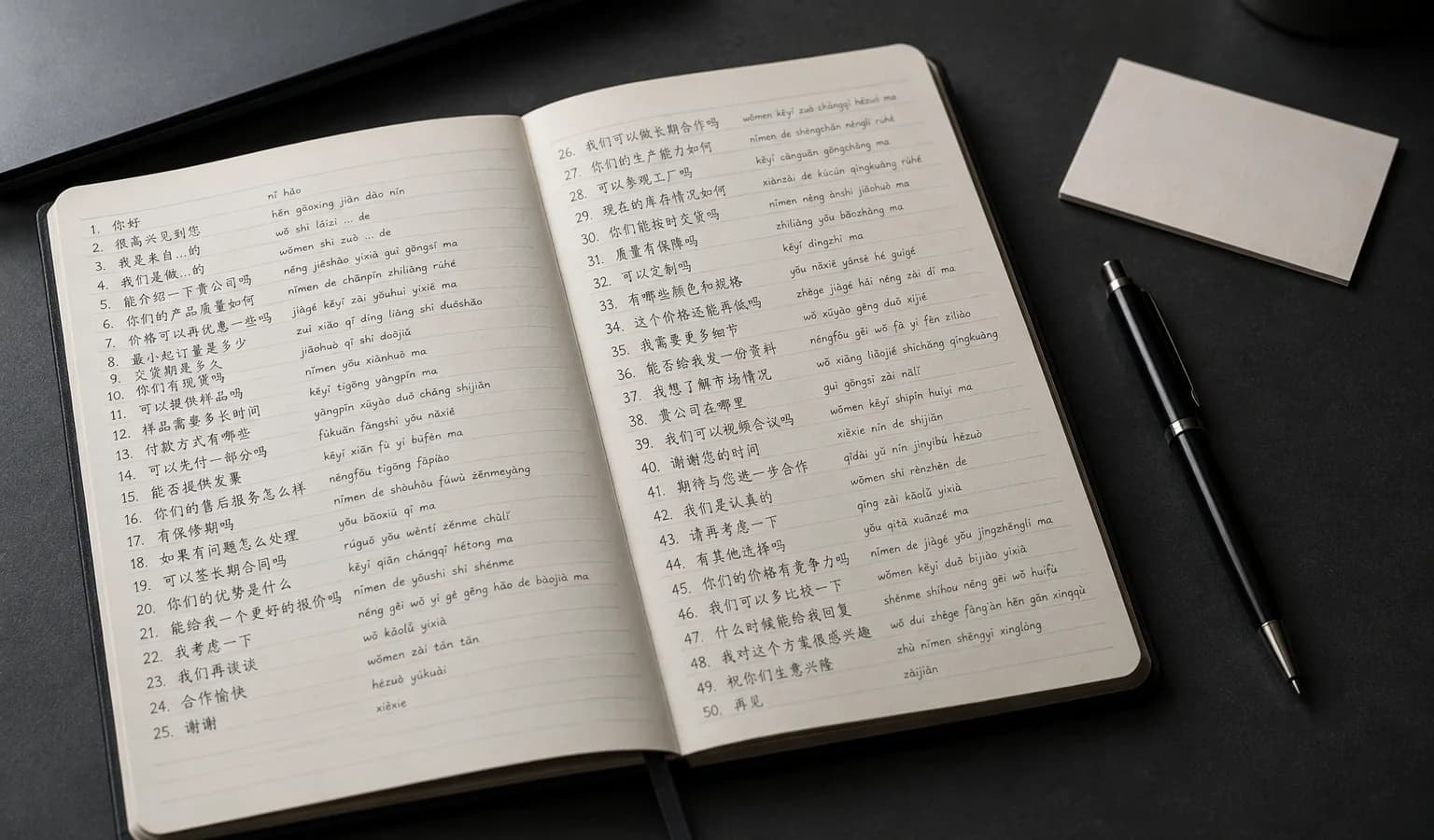
This article covers one scenario: you are having a conversation with a Chinese supplier about price, volume, quality, deadlines and payment terms. There are no legal contract formulations, production audits, logistics or factory sourcing here — those are separate topics. Below are 50 phrases, grouped by negotiation function, with characters, pinyin and an explanation of why a literal translation from English often produces the wrong effect.
A caveat about the limits of applicability. Chinese suppliers are not a homogeneous group. The manner of conversation depends on the region, industry, company size and the specific person. An export manager in Shenzhen, an engineer at a factory in Zhejiang and the owner of a small workshop in Guangdong may negotiate differently. What follows is not a description of a "Chinese character", but a set of working language tools that in most business situations help you express your intention more precisely.
How to read this phrasebook: three politeness strategies
In Chinese business conversation, the same task can be handled in three ways, and the choice of method is not decoration, but part of the meaning.
A direct demand. A formulation in the imperative mood: 你们必须… (nǐmen bìxū… — "you must…"). In negotiations with a supplier this is rarely appropriate: mainly when it concerns a condition that has already been agreed and violated, and you want to signal seriousness. Frequent use of direct demands is perceived as pressure and can wound 面子 (miànzi) — the public standing of the person you are speaking to.
A polite request. Constructions with 请 (qǐng — "please"), 能不能 (néng bu néng — "is it possible"), 是否可以 (shìfǒu kěyǐ — "would it be possible"). This is the working register of most business negotiations: you signal interest, but leave the other person room to respond.
An indirect indication. Formulations that do not name the problem directly, but describe it through difficulty or the need for discussion: 可能有点困难 (kěnéng yǒudiǎn kùnnán — "it may be a little difficult"), 我们再研究一下 (wǒmen zài yánjiū yīxià — "we'll study it further"). This is not evasion of an answer, but a way to preserve face for both sides when a direct "no" is undesirable.
Practical conclusion: if you hear 可能有点困难, do not translate it as "no". And do not translate it as "yes". It is a signal that the proposal in its current form does not pass and a new option is needed — a different volume, a different price, a different deadline.
Section 1. Establishing contact and the framework of the conversation (phrases 1–8)
The first minutes of the conversation set the tone. What matters here is not so much the content as the pace and willingness to listen.
1. 您好,很高兴认识您。 (Nín hǎo, hěn gāoxìng rènshi nín.) — "Hello, glad to meet you". The address 您 (nín) is the polite form of "you", appropriate with a new partner.
2. 我是……公司的采购负责人。 (Wǒ shì…… gōngsī de cǎigòu fùzérén.) — "I am in charge of procurement at the company…". If your role is different, replace 采购负责人 with 项目经理 (xiàngmù jīnglǐ — "project manager") or 业务代表 (yèwù dàibiǎo — "client relations representative").
3. 今天想谈一下价格和交货期。 (Jīntiān xiǎng tán yīxià jiàgé hé jiāohuòqī.) — "Today I would like to discuss the price and delivery deadline". Stating the goal right away saves time and reduces the risk that the meeting drifts into general presentations.
4. 可以慢一点说吗? (Kěyǐ màn yīdiǎn shuō ma?) — "Could you speak a little more slowly?" A phrase worth learning among the first.
5. 请再说一遍。 (Qǐng zài shuō yī biàn.) — "Please repeat that". Neutral and polite.
6. 这个问题谁负责? (Zhège wèntí shéi fùzé?) — "Who is responsible for this matter?" Useful for understanding with whom it makes sense to discuss price and with whom technical details.
7. 我们可以先确认一下基本条件。 (Wǒmen kěyǐ xiān quèrèn yīxià jīběn tiáojiàn.) — "Let's first confirm the basic terms". A calm framework that moves the conversation from the social part to the working part.
8. 谢谢,我们先谈到这里。 (Xièxie, wǒmen xiān tán dào zhèlǐ.) — "Thank you, let's stop here for now". A polite conclusion to a stage without an abrupt cut-off.
Section 2. Price, discount and price structure (phrases 9–18)
Here it is important to distinguish two words that machine translation often reduces to one. 价格 (jiàgé) — "price" as a category or level. 报价 (bàojià) — "quotation", that is, a specific price offer that the supplier sends you. When you ask for 报价, you are requesting a commercial offer; when you say 价格, the conversation is about the price as such.
9. 请给我一个报价。 (Qǐng gěi wǒ yī gè bàojià.) — "Please give me a quotation". A basic phrase for starting a price conversation.
10. 这个价格包含什么? (Zhège jiàgé bāohán shénme?) — "What is included in this price?" The clarification is critical: packaging, delivery to port, VAT, samples — all of these may or may not be included.
11. 价格是按什么数量算的? (Jiàgé shì àn shénme shùliàng suàn de?) — "The price is calculated for what volume?" Without this question it is easy to compare incomparable offers.
12. 这个价格有点高。 (Zhège jiàgé yǒudiǎn gāo.) — "This price is a little high". A soft formulation. The direct 太贵了 (tài guì le — "too expensive") sounds harsher and the first time may be perceived as devaluing the offer.
13. 能不能再优惠一点? (Néng bu néng zài yōuhuì yīdiǎn?) — "Could you give a little more concession on the price?" The important word here is 优惠 (yōuhuì) — "preferential offer, concession". It differs from 折扣 (zhékòu) — "discount" in the sense of a percentage off the price. 折扣 is usually stated as a number (for example, 九五折 — "5% discount", literally "95% of the price"), while 优惠 is a more general request for better terms.
14. 如果数量增加,价格可以降多少? (Rúguǒ shùliàng zēngjiā, jiàgé kěyǐ jiàng duōshǎo?) — "If the volume increases, by how much can the price decrease?" A question that moves the conversation from haggling to discussing structure.
15. 这个价格包括运费吗? (Zhège jiàgé bāokuò yùnfèi ma?) — "Does this price include delivery?" 运费 (yùnfèi) — "shipping cost".
16. 付款条件是什么? (Fùkuǎn tiáojiàn shì shénme?) — "What are the payment terms?" A general question that opens the topic of deposit and prepayment.
17. 我们可以接受这个价格,但有条件。 (Wǒmen kěyǐ jiēshòu zhège jiàgé, dàn yǒu tiáojiàn.) — "We can accept this price, but with a condition". A construction that allows you not to refuse directly, but to set a framework.
18. 请把价格写清楚。 (Qǐng bǎ jiàgé xiě qīngchu.) — "Please write the price clearly". Written recording in price negotiations is important: oral agreements easily diverge in understanding.
Section 3. Batch volume, MOQ and trial order (phrases 19–26)
MOQ — minimum order quantity, the minimum order volume. In Chinese conversation this is most often 起订量 (qǐdìngliàng) or simply 最小订量 (zuìxiǎo dìngliàng).
19. 起订量是多少? (Qǐdìngliàng shì duōshǎo?) — "What is the minimum order quantity?"
20. 我们可以先做一个试单。 (Wǒmen kěyǐ xiān zuò yī gè shìdān.) — "We can first place a trial order". 试单 (shìdān) — "trial order", a common formulation for the first small batch.
21. 试单的数量可以少一点吗? (Shìdān de shùliàng kěyǐ shǎo yīdiǎn ma?) — "Can the trial order be for a smaller volume?"
22. 数量不同,价格怎么算? (Shùliàng bùtóng, jiàgé zěnme suàn?) — "How is the price calculated for different volumes?" A question about tiered pricing.
23. 有没有阶梯价格? (Yǒu méiyǒu jiētī jiàgé?) — "Is there tiered pricing?" 阶梯价格 (jiētī jiàgé) — literally "staircase price", that is, a price that decreases by volume levels.
24. 这个数量我们暂时做不到。 (Zhège shùliàng wǒmen zànshí zuò bù dào.) — "We cannot manage such a volume for now". A formulation of refusal without a direct 不行 (bùxíng — "not possible").
25. 我们可以从少量开始,后面再增加。 (Wǒmen kěyǐ cóng shǎoliàng kāishǐ, hòumiàn zài zēngjiā.) — "We can start with a small volume and increase it later". A way to signal a prospect without promising specific numbers.
26. 如果试单顺利,我们会下正式订单。 (Rúguǒ shìdān shùnlì, wǒmen huì xià zhèngshì dìngdān.) — "If the trial order goes well, we will place the main order". 正式订单 (zhèngshì dìngdān) — "official order".
Section 4. Quality, samples and specifications (phrases 27–34)
In a conversation about quality, it is important to separate the description of a requirement from pointing out a problem. The first is neutral; the second may be perceived as a complaint if formulated harshly.
27. 可以先寄样品吗? (Kěyǐ xiān jì yàngpǐn ma?) — "Can you send a sample first?" 样品 (yàngpǐn) — "sample".
28. 样品费和运费怎么算? (Yàngpǐnfèi hé yùnfèi zěnme suàn?) — "How are the cost of the sample and the shipping calculated?"
29. 请按照这个规格做。 (Qǐng ànzhào zhège guīgé zuò.) — "Please make it according to this specification". 规格 (guīgé) — "specification, standard".
30. 允许的误差是多少? (Yǔnxǔ de wùchā shì duōshǎo?) — "What is the permissible tolerance?" 误差 (wùchā) — "deviation, error".
31. 这批货和样品一致吗? (Zhè pī huò hé yàngpǐn yīzhì ma?) — "Does this batch match the sample?" 一致 (yīzhì) — "to correspond, to be identical".
32. 我们发现了一些问题。 (Wǒmen fāxiàn le yīxiē wèntí.) — "We have discovered some problems". A neutral statement, without accusation.
33. 能不能一起看一下怎么解决? (Néng bu néng yīqǐ kàn yīxià zěnme jiějué?) — "Can we look together at how to solve this?" A formulation that moves the conversation from a complaint to a joint search for a solution.
34. 我们希望下一批能改进。 (Wǒmen xīwàng xià yī pī néng gǎijìn.) — "We hope the next batch will be better". 改进 (gǎijìn) — "to improve, to refine".
Section 5. Deadlines, payment and shipment (phrases 35–44)
Here there are a couple of terms that sound the same but differ in meaning. 定金 (dìngjīn) and 订金 (dìngjīn) are pronounced the same, but in a legal context they carry a different load: 定金 is usually understood as a deposit with a security function, 订金 as a prepayment without such a function. Aurally they cannot be distinguished, so in important matters it is better to clarify in writing which character the word is written with. This is not legal advice, but an indication that the topic should be checked separately.
35. 交货期是多久? (Jiāohuòqī shì duōjiǔ?) — "What is the delivery deadline?"
36. 生产需要多长时间? (Shēngchǎn xūyào duō cháng shíjiān?) — "How much time will production take?" 生产 (shēngchǎn) — "production".
37. 能不能给一个生产计划? (Néng bu néng gěi yī gè shēngchǎn jìhuà?) — "Can you give a production schedule?"
38. 付款方式是怎样的? (Fùkuǎn fāngshì shì zěnyàng de?) — "What is the payment method?"
39. 定金是多少? (Dìngjīn shì duōshǎo?) — "What is the deposit amount?" When clarifying in writing, it is worth asking which character is meant.
40. 余款什么时候付? (Yúkuǎn shénme shíhou fù?) — "When is the balance paid?" 余款 (yúkuǎn) — "remaining amount".
41. 交货前可以验货吗? (Jiāohuò qián kěyǐ yànhuò ma?) — "Can the goods be inspected before shipment?" 验货 (yànhuò) — "inspection of goods".
42. 交货港口是哪个? (Jiāohuò gǎngkǒu shì nǎge?) — "Which is the port of shipment?"
43. 贸易术语用哪个? (Màoyì shùyǔ yòng nǎge?) — "Which trade term is used?" This refers to Incoterms (FOB, CIF, EXW and others). The exact wording of the terms is better clarified in the contract, not in oral conversation.
44. 请把交货时间写在合同里。 (Qǐng bǎ jiāohuò shíjiān xiě zài hétóng lǐ.) — "Please write the delivery deadline into the contract". Recording deadlines in writing is not distrust, but a working norm.
Section 6. Difficult moments: refusal, pressure, pausing, repeated request (phrases 45–50)
These six phrases are not about the content of the deal, but about managing the conversation when it reaches a dead end or becomes too tense.
45. 这个条件我们暂时不能接受。 (Zhège tiáojiàn wǒmen zànshí bùnéng jiēshòu.) — "We cannot accept this condition for now". The word 暂时 (zànshí — "for now, temporarily") leaves the door open and softens the refusal.
46. 我们需要再考虑一下。 (Wǒmen xūyào zài kǎolǜ yīxià.) — "We need to think it over further". A polite pause that does not look like an ultimatum.
47. 能不能换个方式谈? (Néng bu néng huàn gè fāngshì tán?) — "Can we discuss this differently?" A way to bring the conversation back on track if it has drifted aside.
48. 我理解您的立场,但我们也有困难。 (Wǒ lǐjiě nín de lìchǎng, dàn wǒmen yě yǒu kùnnán.) — "I understand your position, but we also have difficulties". Acknowledging the other person's position reduces the risk of being perceived as pressure.
49. 我们今天的讨论很有帮助。 (Wǒmen jīntiān de tǎolùn hěn yǒu bāngzhù.) — "Today's discussion was helpful". A formula for concluding a stage that preserves tone even after a difficult conversation.
50. 希望我们以后能长期合作。 (Xīwàng wǒmen yǐhòu néng chángqī hézuò.) — "I hope we can cooperate long-term in the future". 长期合作 (chángqī hézuò) — "long-term cooperation", a standard formula with which it is appropriate to end negotiations.
Mini-dictionary: terms that cannot be translated with one word
Below is only what is needed for negotiating a deal. Each pair shows where machine translation or hasty equating can lead to misunderstanding.
- 工厂 (gōngchǎng) — a production unit, a factory. 供应商 (gōngyìngshāng) — a supplier, which may also be a trading company that does not have its own production. 贸易公司 (màoyì gōngsī) — a trading company. The difference matters: with a trading company the price is usually higher, but the assortment is broader, while with a factory it is lower, but the choice is narrower.
- 定金 (dìngjīn) and 订金 (dìngjīn) — sound the same, differ legally. Clarify the spelling.
- 价格 (jiàgé) — price as a category. 报价 (bàojià) — quotation, a specific offer.
- 折扣 (zhékòu) — a discount as a percentage off the price. 优惠 (yōuhuì) — a preferential offer, a concession in a broader sense.
Practical notes: tone, pace and written recording
Three things that are not in the phrase list, but influence the result no less.
Tone and pace. Chinese business conversation often moves more slowly than a familiar Western meeting. A pause after a question is not a sign that you were not understood, but time for reflection. Do not fill it with new arguments.
Written recording. Everything concerning price, volume, deadlines and payment terms makes sense to confirm in writing — in an email or a messenger. An oral agreement in conversation and its written version may diverge, and this is not necessarily bad faith: that is how the difference between oral and written communication works.
The limits of language. Knowing phrases in Chinese does not replace an interpreter in legally significant matters. The contract, specification and payment terms are areas where a mistake in one character can be costly. Chinese here helps establish contact and clarify details, but does not take on the role of legal language.
FAQ
Do you need to learn tones to use these phrases?
Tones are important, but not absolute. In business conversation the context often suggests the meaning, and a supplier accustomed to working with foreigners usually understands a phrase even with an inaccurate tone. However, some pairs of words differ only by tone, and a mistake can change the meaning. If you are just starting out, it is better to learn a few key phrases with the correct tone than many with an approximate one.
Can these phrases be used in WeChat?
Yes, most of them are appropriate in messaging as well. In WeChat it is worth considering that written conversation is shorter than oral: long polite constructions may look ponderous. In messaging, short forms are used more often: 报价多少? (Bàojià duōshǎo? — "How much is the quotation?"), 什么时候交货? (Shénme shíhou jiāohuò? — "When is delivery?").
What should you do if the supplier answers in a dialect?
Dialects in China are diverse, and in some regions local speech can differ greatly from Putonghua. In a business context, export managers usually speak Putonghua, but factory workers do not always. If you do not understand the answer, politely ask them to repeat it in Putonghua: 请说普通话。 (Qǐng shuō pǔtōnghuà.) — "Please speak Putonghua".
How should you address a supplier by name?
In the Chinese business environment it is customary to address a person by surname with the addition of a position or polite title: 王经理 (Wáng jīnglǐ — "Manager Wang"), 李总 (Lǐ zǒng — "Mr. Li", literally "General Li"). Addressing someone by given name without the surname, customary in the West, may sound overly familiar in China. If you are unsure of the position, use 先生 (xiānsheng — "Mr.") or 女士 (nǚshì — "Ms.").
Is English enough in negotiations with a Chinese supplier?
At many business meetings — yes, especially when it concerns large export companies. In this case Chinese performs more the function of establishing contact and clarifying than of the main language of the deal. But in situations where the conversation is with an engineer, a section supervisor or the owner of a small workshop, English may not be enough, and then even a few phrases in Chinese change the tone of the conversation.