An entrepreneur who starts working with China almost always asks the same question: should I learn Chinese, and if so, where do I start? The answer depends not on motivation, but on which tasks you intend to handle personally. If you visit factories, correspond with suppliers, discuss samples and deadlines, basic Chinese pays off quickly. If you work through a purchasing agent or sell on a marketplace, the priorities will be different. Below is a practical route in: what levels of proficiency exist, what you actually need at the start, in what order to move, and how to tell that you are making progress rather than imitating learning.
The short answer: three levels that shouldn't be mixed up
The main mistake is treating "business Chinese" as a single goal. In practice it is three different levels, and it's best to separate them right away.
- Spoken business minimum. Greet someone, introduce yourself, name your company and your role, understand a question about price, quantity, or deadlines, confirm or clarify what was said. This is the level of personal contact: it removes some of the distance and lets you hear the conversation, not just the translation.
- Written minimum. Recognize standard constructions in incoming WeChat messages, read an invoice, a specification, a short letter, understand where you are being asked to clarify and where you are being turned down. You can reply in English or through an interpreter — what matters is understanding what was written to you.
- Working level. Conduct negotiations independently, discuss terms, objections, compromises, legal nuances. This is a separate, multi-year undertaking, and for most entrepreneurs it is not necessary.
At the start it makes sense to invest in the first level and partly in the second. The third is an option, not a mandatory bar. The amount of effort depends on the industry, the average deal size, whether you have an in-house interpreter, and the partner's region: in coastal provinces and in companies' export departments, English is more widespread than in inland regions and at enterprises oriented toward the domestic market. This is a tendency, not a rule, and it doesn't remove the need to at least understand what is happening around you.
Why English is often enough — and where it stops working
At trade shows, in correspondence with factories' export departments, and in typical procurement, English really is enough. Booth salespeople have worked with foreigners for years, many have ready-made price lists and catalogs in English, and the managers handling major clients speak fluently. This is not a myth or a polite formality.
English stops working where the decision is made not by the export manager but by the owner, a technical specialist, or an employee for whom the external market is not the main area of responsibility. This could be a discussion of production technology, domestic logistics, hiring staff, working with local suppliers, or participating in tenders. In such situations you either hear a conversation in which part of the meaning is lost in translation, or you end up outside the communication altogether.
The practical conclusion is not that "English isn't enough," but that it's worth distinguishing where you work through an intermediary and where you need your own access to the conversation. The latter is the real reason to learn the language.
What basic Chinese actually gives an entrepreneur
The benefit of a basic level is not that you will "start speaking," but several specific effects.
- Speed of establishing contact: a few phrases in Chinese at the start of a meeting change the framing of the conversation, even if you switch to English afterward.
- The ability to read a sign, an invoice, a specification, a short notice — things that aren't translated because they're considered obvious.
- Understanding the tone of a conversation between partners: where they are discussing, where they are arguing, where they are joking, where they are dodging the topic.
- The ability to notice a discrepancy between what is translated and what is said. This is not about distrusting the interpreter, but about an additional channel of information.
It's important to distinguish between two skills. Listening comprehension and speaking are mastered at different rates. In an adult, passive comprehension often develops faster than active speech, and for business tasks this may be enough: you understand what is happening even if you answer briefly or through an interpreter.
The starting set: pronunciation, tones, pinyin
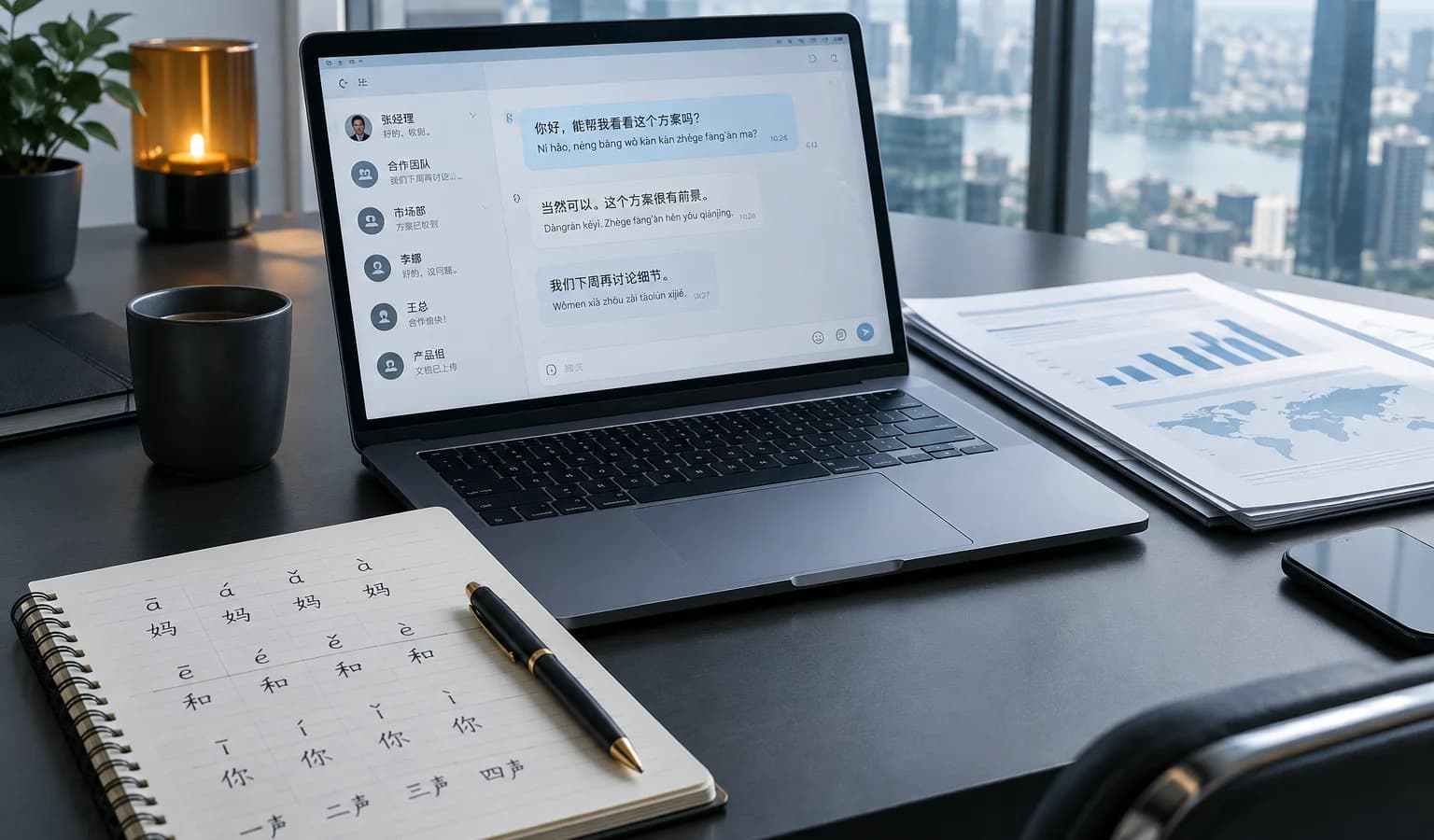
Tones (声调, shēngdiào) in Putonghua perform a meaning-distinguishing function: the same syllable with a different tone can denote different words. This is not a decorative detail or an "accent" that can be put off. If tones are not established in the first weeks, they then become fixed incorrectly, and relearning is harder than learning from scratch.
The practical order is this: first phonetics and tones, in parallel — pinyin as a system of notation and input. Pinyin is the official system for romanizing Chinese based on the Latin alphabet; it is used for teaching pronunciation and for inputting text on a computer and phone. For an entrepreneur this is not an academic topic but a working tool: without pinyin you won't be able to type messages or look up words in a dictionary.
Characters (汉字, hànzì) are needed at the start in a limited volume — at the level of recognition, not handwriting. Recognizing several hundred characters that appear in your correspondence and documents is more useful than learning to write them calligraphically. Handwriting is a separate skill that is rarely required in business practice.
Vocabulary: not "business Chinese" in general, but your industry minimum
Textbooks of "business Chinese" often provide a general set: meetings, banquets, presentations. For real work this is not enough, because your language is the language of your product category and your recurring situations.
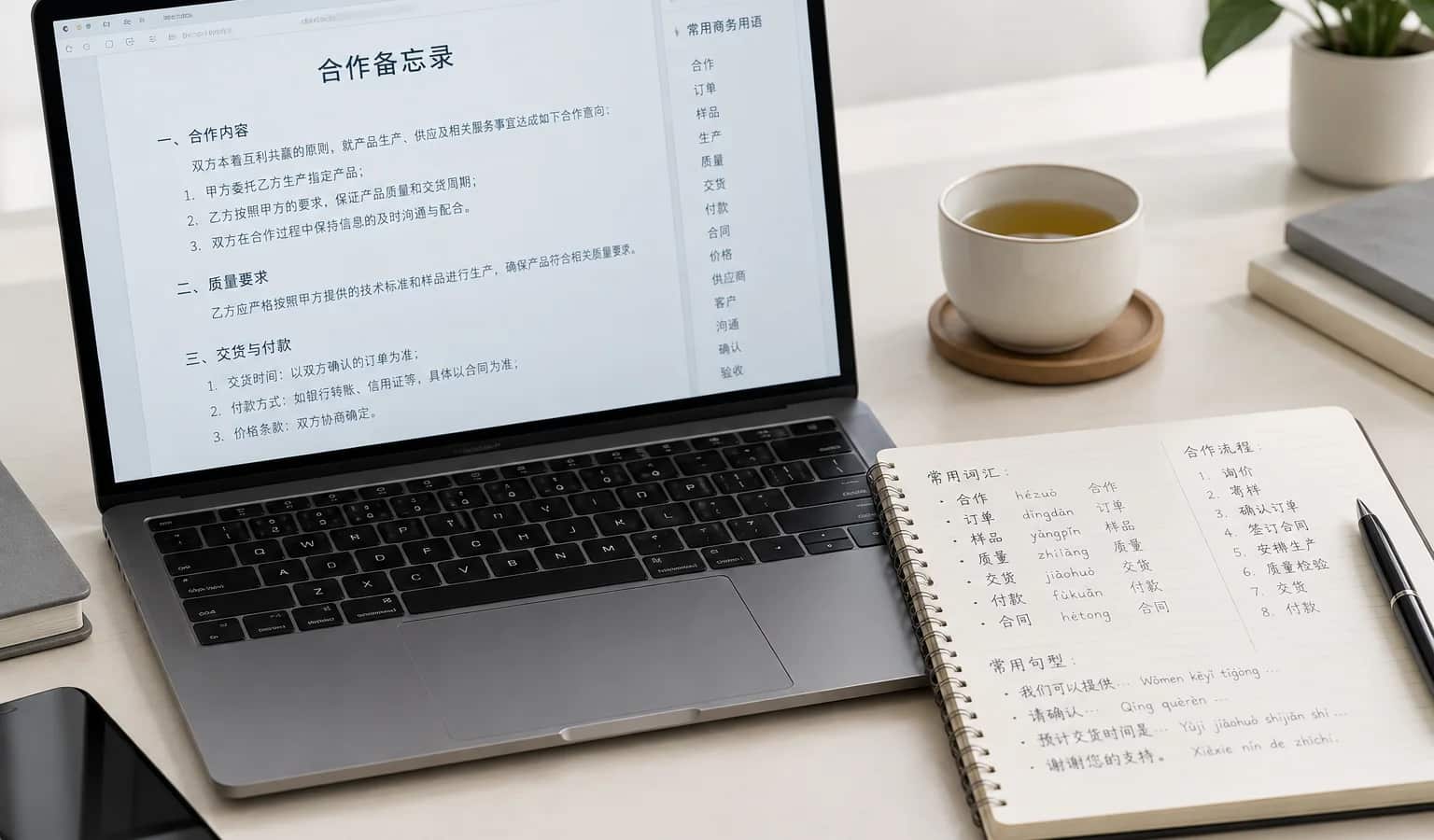
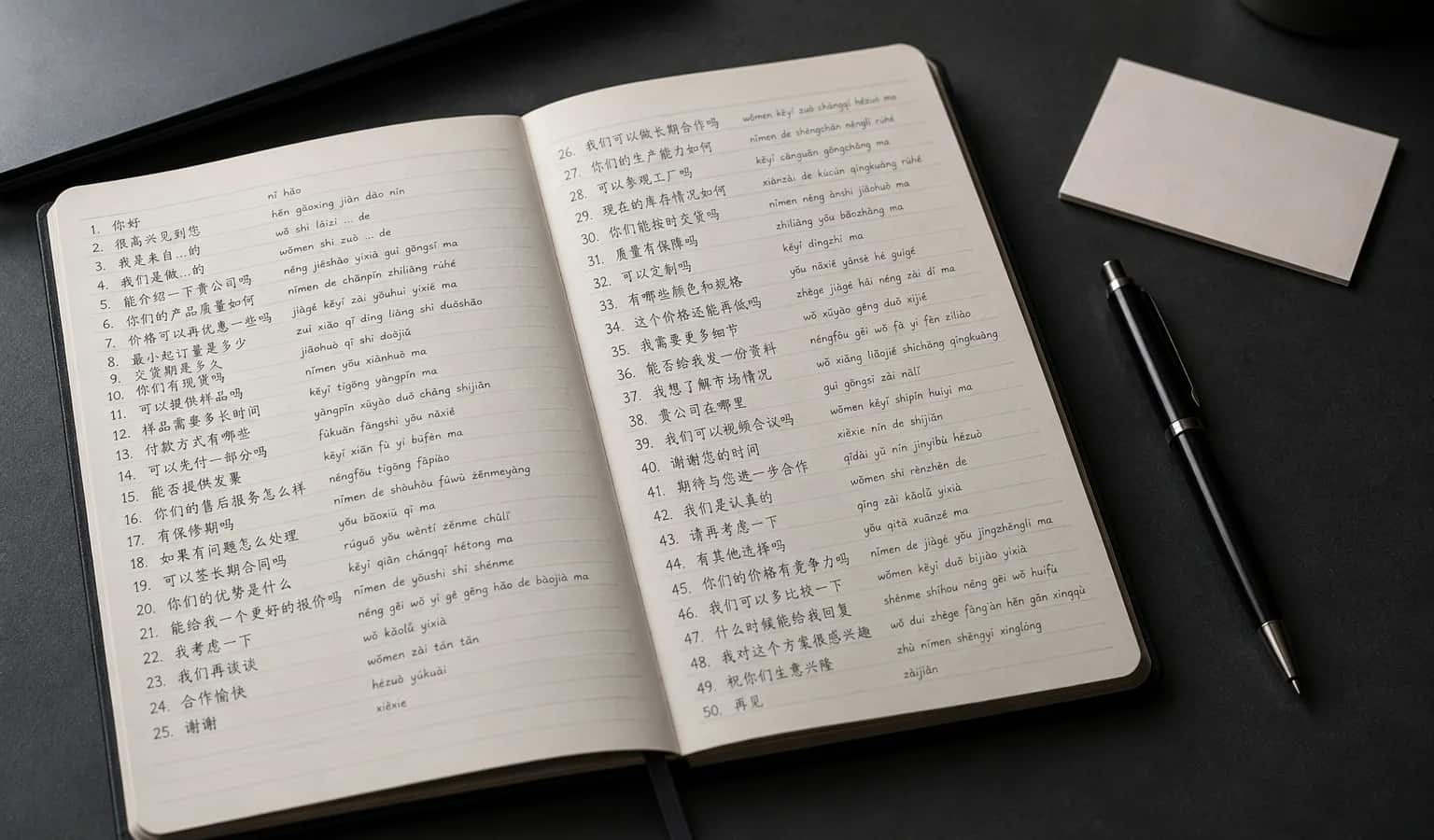
The logic of selection is simple. Take your correspondence from recent months and write down what is discussed most often: product characteristics, packaging, samples, deadlines, payment, shipping, claims. Then add the roles of the parties: who writes to you, who makes the decision, who is responsible for quality. From this a personal list takes shape, one worth bringing to automaticity. A benchmark is 200–300 units tied to specific recurring situations, not a thousand words "for the future."
Ready-made lists of phrases for negotiations and dictionaries by deal stage are separate materials, and there's no point duplicating them here. More important is the principle: learn what you will encounter this week, not what might come in handy someday.
Written communication: where Chinese pays off fastest
For many entrepreneurs the written channel turns out to be more advantageous than the spoken one. WeChat (微信, Wēixìn) is widely used in China as a working tool: samples are agreed through it, photos are sent, deadlines are clarified, current issues are resolved. This is a widespread practice, not a formal standard, but it shouldn't be ignored.
The written register differs from the spoken one. In correspondence there are more template politeness formulas, standard openings and closings, and set phrases for clarifying and declining. It's worth recognizing them on sight, even if you reply in English: this lets you understand incoming messages without an interpreter and avoid wasting time on clarifications.
A separate note on machine translation. It fails not so much on grammar as on roles and terms: it translates different types of companies with one word, doesn't distinguish deal stages, and confuses terms that sound similar but differ in meaning. In business correspondence such an error can cost money. So machine translation is reasonable for a draft, but not for messages involving terms, deadlines, or money.
How to learn when time is short: a routine, not motivation
An entrepreneur usually has motivation — but no time. So what works is not a crash course but a routine.
- Short daily sessions are better than rare long ones: 15–20 minutes every day gives more than three hours once a week.
- Tie it to work tasks: learn words from your own correspondence, work through real invoices and catalogs, not abstract texts.
- Listening from the first month: without it you will read but not understand speech.
- Regular testing in real situations: a voice message on WeChat, a short call, a conversation at the factory.
A course with a teacher and independent study solve different tasks. A teacher is needed where pronunciation and feedback matter; for building vocabulary and listening, independent work is effective. A native speaker is useful for speaking practice but doesn't replace structure. I won't name specific schools and apps here: without verifiable data that would be advertising, not advice.
When to hire an interpreter and when to hire a bilingual employee
This is not one role but several, and confusing them is costly.
- Interpreter at negotiations — ensures accuracy of wording but does not negotiate for you. The mistake is using an interpreter as a negotiator: they convey meaning, they don't defend your interests.
- Assistant for correspondence — handles day-to-day communication, tracks deadlines, clarifies details. Here discipline and knowledge of your product category matter more than brilliant language skills.
- Technical specialist with language skills — needed where production, materials, and quality are discussed. This is a rare and valuable role, and neither an interpreter nor an assistant can replace it.
A separate note on translating a contract. Cutting corners on it is a bad idea: legal wording doesn't tolerate approximation, and machine translation is especially dangerous here. The specific requirements for the language of the contract and its translation depend on the applicable law and require verification against current legislation, so I won't provide details here.
Typical first-year mistakes
- Learning the language "in general," without tying it to tasks: there's progress, but no benefit.
- Ignoring tones in the hope that "they'll understand from context." Sometimes they will, but not always.
- Betting only on characters and reading while putting off listening. In real communication, hearing matters more.
- Using polite formulas without understanding their register: what is appropriate in a letter sounds strange in conversation, and vice versa.
- Assuming that an HSK level equals negotiation readiness. HSK is a standardized exam that tests language skills, not the ability to negotiate and not knowledge of business context. It is a structural benchmark, not a guarantee.
How to measure progress without self-deception
The number of words learned is a poor indicator. It's more useful to tie progress to work situations.
- You understand the key information in a WeChat voice message without translation.
- You read an invoice or specification and see a discrepancy with what was discussed.
- You sustain a short conversation without an interpreter: greeting, exchange of remarks, clarification.
- You recognize a refusal in indirect form, without mistaking a polite formula for agreement.
If at least two of these hold true, you are moving forward. If none do, it's worth revisiting your routine rather than blaming your abilities.
FAQ
Do I need Chinese if I always have an interpreter with me?
An interpreter ensures accuracy but doesn't replace your access to the conversation. A basic level lets you understand the context, notice discrepancies, and participate in communication rather than just receiving its result. This is especially important where the decision is made not by the export manager but by the owner or a technical specialist.
How much time is needed to reach a working level?
Exact timelines can't be given: they depend on intensity, starting level, methodology, and your language background. It's more realistic to speak not of a timeline to a "working level" but of sequential tasks: first phonetics and tones, then industry vocabulary, then written comprehension, then speaking practice. Each stage has its own horizon.
Does HSK help in business?
HSK is a standardized exam that tests language skills. It is useful as a structural benchmark and as an external check on progress, but it doesn't guarantee negotiation readiness and doesn't replace knowledge of business context. Treat it as one of the tools, not as the goal.
Should I learn traditional characters?
For working with mainland China, simplified characters are enough. Traditional ones are found in Hong Kong, Taiwan, and some historical texts. If your partners work in those regions, it makes sense to learn to recognize traditional forms, but you shouldn't start with them.
Can I get by with pinyin in correspondence?
Pinyin is convenient for input and memorization, but in business correspondence it doesn't replace characters: a message typed in Latin letters looks nonstandard and may be hard to understand. Pinyin is a tool for learning and input, not a format for business communication.