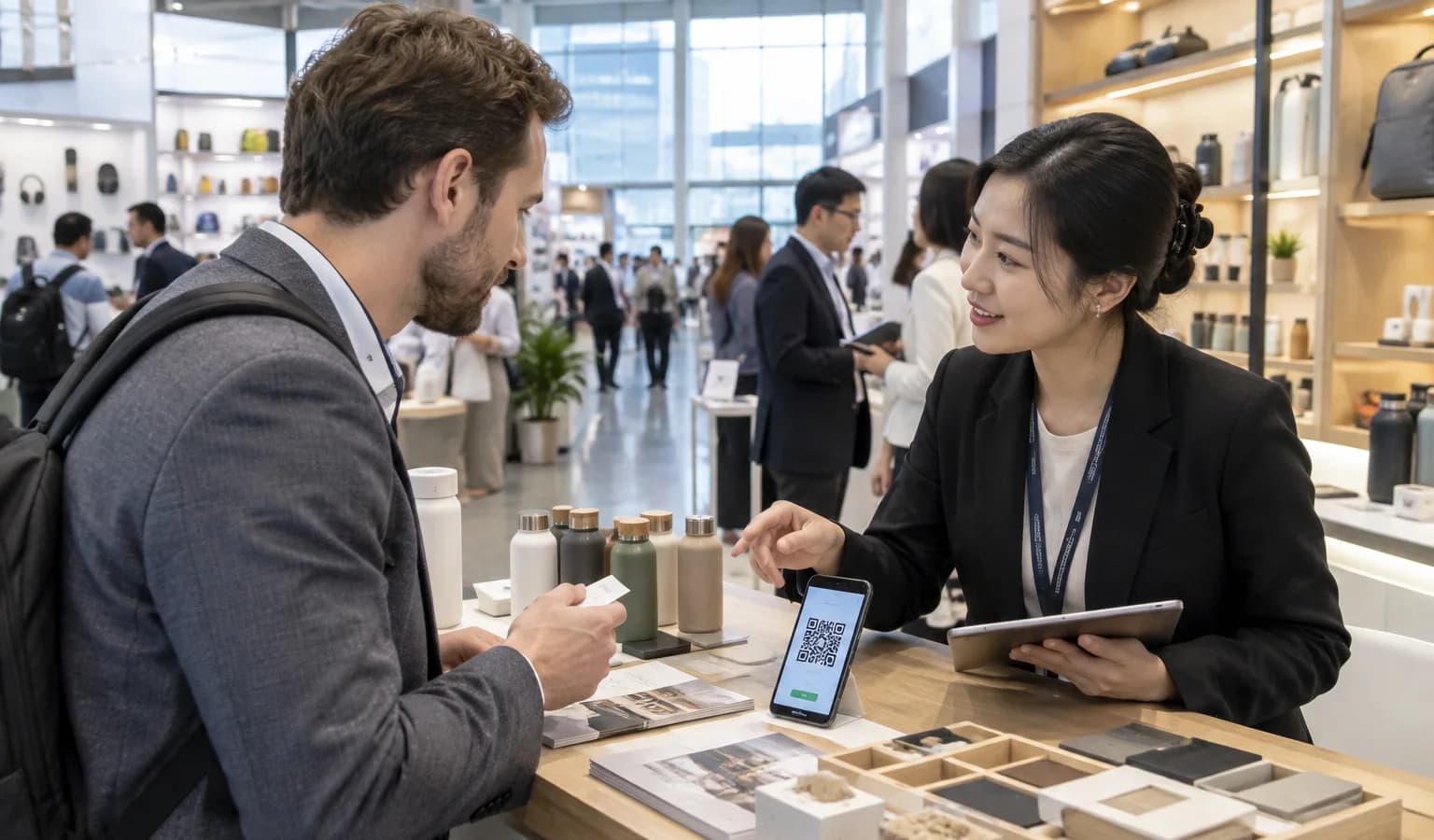
The Canton Fair (广交会, Guǎngjiāohuì) is China's largest comprehensive trade show, held in Guangzhou twice a year. For a buyer, it is not one long negotiation session but dozens of short contacts: two or three minutes at a booth, noise, crowds, a queue of other buyers behind you. The language of the exhibition hall differs both from correspondence with a supplier and from calm negotiations in an office. What is valued here are short, precise phrases that immediately set the frame of the conversation and let you quickly understand whether it is worth continuing.
Below is not a universal Chinese textbook and not a complete guide to the exhibition. It is a set of expressions for a specific communicative scenario: approaching a booth, explaining what you need, asking for the price, MOQ and samples, exchanging contacts, politely ending the conversation, and moving on to the next booth. The Chinese terms are given with pinyin and translation; where the translation does not convey the communicative effect, this is explained separately.
Why the Canton Fair Requires Its Own Set of Phrases
In correspondence with a factory, you have time to choose your words, check the translation, reread the reply. At a booth, there is no such time. The conversation takes place under conditions that linguists call a "noisy channel": it is loud around you, you may be interrupted, and the salesperson is simultaneously watching other visitors. In such a situation, what wins is not complex constructions but short formulas that the interlocutor recognizes instantly.
The second difference is the goal of the conversation. At a trade show, you do not close a deal. You solve a narrower task: screening out unsuitable suppliers and collecting the contacts of those worth corresponding with after you return. This also changes the vocabulary. You need not phrases for haggling but phrases for quick qualification: who the manufacturer is, what the product is, what the price is, what the minimum order is, whether a sample can be obtained.
The third difference is roles. At a booth, you are almost always talking not with the factory owner but with an export manager. He may be an employee of a trading company rather than the manufacturer itself. The distinction between 工厂 (gōngchǎng, manufacturing factory) and 供应商 (gōngyìngshāng, supplier, which may also be a trading company) is especially practical at a trade show: the price and responsibility for quality depend on it. This distinction is examined in more detail in a separate article, "Chinese Words for Working with Factories"; here it is enough to remember that the question "are you a factory or a trading company?" is appropriate and useful.
How Communication at a Booth Works: Three Phases of Conversation
A conversation at a booth usually goes through three phases, and each has its own set of phrases.
The first phase is the approach and first contact. You attract attention, greet the person, and briefly state your interest. Politeness and speed matter here: the salesperson must understand within a few seconds that you are not a random passerby.
The second phase is substantive. You explain what you are looking for and ask for the price, MOQ (minimum order quantity) and samples. This is the most intensive part of the conversation, and this is where words are most often lacking.
The third phase is the conclusion. You either agree on the next step and exchange contacts, or politely leave. Knowing how to end a conversation is just as important as knowing how to start it: at a large trade show you physically will not have time for every booth, and moving on to the next one is part of the job.
Phrases for Approaching a Booth and Making First Contact
Start with a greeting. 你好 (nǐ hǎo) — "hello" — is universal and neutral. If you have already greeted this person, 您好 (nín hǎo) — the polite form — is appropriate. In a business context at a trade show, 您好 sounds slightly more respectful and is often preferable.
Then state your interest. The phrase 我可以看一下吗?(wǒ kěyǐ kàn yíxià ma?) — "may I take a look?" — opens the conversation and lets the salesperson know that you are considering the product. If you want to get straight to the point, say 我对这个产品感兴趣 (wǒ duì zhège chǎnpǐn gǎn xìngqù) — "I am interested in this product."
It is useful to introduce yourself right away and state your role. 我是采购商 (wǒ shì cǎigòushāng) — "I am a buyer / purchaser." This is a short phrase that changes the attitude: you are not a tourist but a potential client.
If you have a business card, hold it out and say 这是我的名片 (zhè shì wǒ de míngpiàn) — "this is my business card." In Chinese business practice, it is customary to accept a business card with both hands and briefly look it over; this is not a formality but a sign of respect.
How to Explain What You Need If You Do Not Know the Exact Term
At a trade show, you may not know the exact Chinese name of a product. That is normal. Instead of staying silent, use descriptive constructions.
The phrase 我要找类似的产品 (wǒ yào zhǎo lèisì de chǎnpǐn) — "I am looking for a similar product" — lets you show a sample or a photo on your phone. If you have a sample, say 这是样品 (zhè shì yàngpǐn) — "this is a sample."
If you are not sure about a term, ask 这个中文怎么说?(zhège zhōngwén zěnme shuō?) — "how do you say this in Chinese?" This question is useful not only for language learning: it engages the interlocutor and often leads to the salesperson himself suggesting the right word.
You can also use 你们有这种产品吗?(nǐmen yǒu zhè zhǒng chǎnpǐn ma?) — "do you have this kind of product?" Note 你们 (nǐmen) — "you" in the plural, that is, addressing the company rather than a specific person. In business Chinese this is standard.
Phrases for Asking About Price, MOQ and Samples
This is the core of the conversation at a booth. Start with the price: 这个多少钱?(zhège duōshao qián?) — "how much does this cost?" At a trade show, the price is often quoted in yuan or dollars; clarify the currency: 是人民币还是美元?(shì rénmínbì háishì měiyuán?) — "is that in yuan or in dollars?"
An important question is the minimum order quantity. 起订量是多少?(qǐdìngliàng shì duōshao?) — "what is the minimum order?" The word 起订量 (qǐdìngliàng) — "minimum order quantity" — is understood at a trade show by everyone who works with exports. If you did not catch it, ask them to repeat: 请再说一遍 (qǐng zài shuō yí biàn) — "please repeat that."
Samples are a separate topic. 我可以拿一个样品吗?(wǒ kěyǐ ná yí ge yàngpǐn ma?) — "may I take a sample?" Often salespeople give samples for free or for a small fee; clarify: 样品免费吗?(yàngpǐn miǎnfèi ma?) — "is the sample free?" If the sample is paid, ask 样品费可以退吗?(yàngpǐn fèi kěyǐ tuì ma?) — "is the cost of the sample refundable?" This is a standard question: many suppliers deduct the cost of the sample from the first order.
It is useful to clarify the timeline right away: 交货期是多久?(jiāohuòqī shì duōjiǔ?) — "what is the delivery time?" And the payment terms: 付款方式是什么?(fùkuǎn fāngshì shì shénme?) — "what are the payment terms?" At a trade show, you will most likely be told the standard terms, but it is worth recording them in your notes.
If the price seems high, do not start haggling right away. At a booth, it is more appropriate to ask 可以便宜一点吗?(kěyǐ piányi yìdiǎn ma?) — "could it be a little cheaper?" This is a soft form that does not look like pressure. Remember that 我们考虑一下 (wǒmen kǎolǜ yíxià) — "we will think about it" — in a salesperson's mouth often means not interest but a way to close the topic without saying "no." This turn of phrase is examined in detail in the article "50 Chinese Phrases for Negotiating with a Supplier."
Phrases for Exchanging Contacts and Recording Agreements
Exchanging contacts is the main practical result of a booth visit. If you do not have a business card, say 我没有名片,可以加微信吗?(wǒ méiyǒu míngpiàn, kěyǐ jiā Wēixìn ma?) — "I do not have a business card, may I add you on WeChat?" WeChat (微信, Wēixìn) is the main business messenger in China; exchanging contacts through it is often more convenient than email.
If you want to receive information later, say 可以发资料给我吗?(kěyǐ fā zīliào gěi wǒ ma?) — "can you send me the materials?" Clarify where to: 发到我的邮箱 (fā dào wǒ de yóuxiāng) — "to my email."
It is useful to record the agreement out loud: 我们保持联系 (wǒmen bǎochí liánxì) — "we will keep in touch." This is a standard polite formula that ends the conversation and leaves the door open.
If you want to schedule a meeting, say 可以约个时间吗?(kěyǐ yuē ge shíjiān ma?) — "can we arrange a time?" At a trade show, many suppliers work on a schedule, and a meeting may be set for the next day.
How to Politely End a Conversation and Leave a Booth
Knowing how to leave is part of trade show work. You do not need to wait until the conversation dies out. Use the phrase 谢谢,我再看看 (xièxie, wǒ zài kànkan) — "thank you, I will look around a bit more." This is polite, neutral, and does not commit you to a decision.
If you want to leave the possibility of returning, say 我待会儿再来 (wǒ dāihuìr zài lái) — "I will come by a little later." This is neither a lie nor a promise: at a trade show, buyers really do often come back.
As you end the conversation, thank the person: 谢谢你的介绍 (xièxie nǐ de jièshào) — "thank you for the explanation." This is respectful and leaves a good impression.
Phrases for Navigating the Complex and Handling Everyday Tasks
The Canton Fair takes place in a large exhibition complex, and navigating it is a task in itself. Useful phrases: 请问,怎么去A区?(qǐngwèn, zěnme qù A qū?) — "excuse me, how do I get to zone A?" Note 请问 (qǐngwèn) — a polite "excuse me, may I ask"; most questions to strangers begin with it.
If you are looking for a specific company's booth, ask 请问,XX公司的展位在哪里?(qǐngwèn, XX gōngsī de zhǎnwèi zài nǎlǐ?) — "excuse me, where is company XX's booth?" The word 展位 (zhǎnwèi) — "booth, exhibition space."
Everyday tasks: 洗手间在哪里?(xǐshǒujiān zài nǎlǐ?) — "where is the restroom?"; 出口在哪里?(chūkǒu zài nǎlǐ?) — "where is the exit?"; 附近有餐厅吗?(fùjìn yǒu cāntīng ma?) — "is there a restaurant nearby?"
What Not to Say at a Booth
There are phrases that work against you in a trade show context. Do not start with 太贵了 (tài guì le) — "too expensive" — before you have learned the price and terms. This is perceived as an automatic reaction rather than an argument.
Do not promise more than you can deliver: 我一定买 (wǒ yídìng mǎi) — "I will definitely buy" — sounds unserious and reduces trust. At a trade show, cautious formulations are valued: 我考虑一下 (wǒ kǎolǜ yíxià) — "I will think about it" — is more honest and more professional.
Do not ask questions whose answers you are not prepared to hear. For example, 你们是最低价吗?(nǐmen shì zuìdī jià ma?) — "is yours the lowest price?" — almost always gets an affirmative answer that means nothing. Better to ask specifically: 如果订单量增加,价格可以再谈吗?(rúguǒ dìngdān liàng zēngjiā, jiàgé kěyǐ zài tán ma?) — "if the order volume increases, can the price be discussed again?"
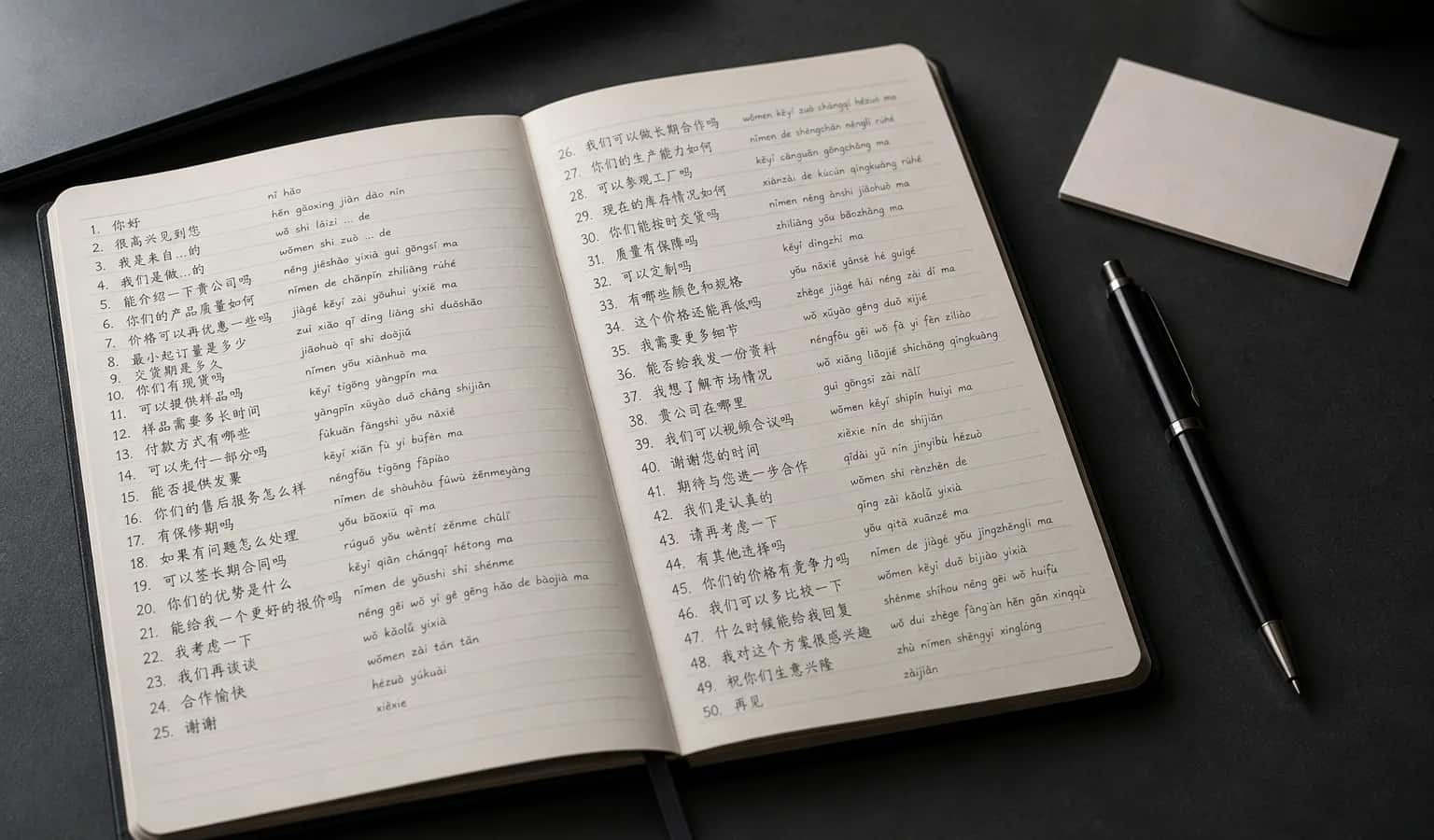
Mini-Phrasebook: 25 Phrases with Pinyin and Translation
Below is a summary of the main phrases for quick access. The table does not replace the explanations above, but it is convenient as a cheat sheet.
| Chinese | Pinyin | Translation |
|---|---|---|
| 您好 | nín hǎo | hello (polite) |
| 我是采购商 | wǒ shì cǎigòushāng | I am a buyer / purchaser |
| 我对这个产品感兴趣 | wǒ duì zhège chǎnpǐn gǎn xìngqù | I am interested in this product |
| 我可以看一下吗? | wǒ kěyǐ kàn yíxià ma? | may I take a look? |
| 这是样品 | zhè shì yàngpǐn | this is a sample |
| 这个中文怎么说? | zhège zhōngwén zěnme shuō? | how do you say this in Chinese? |
| 你们有这种产品吗? | nǐmen yǒu zhè zhǒng chǎnpǐn ma? | do you have this kind of product? |
| 这个多少钱? | zhège duōshao qián? | how much does this cost? |
| 是人民币还是美元? | shì rénmínbì háishì měiyuán? | is that in yuan or in dollars? |
| 起订量是多少? | qǐdìngliàng shì duōshao? | what is the minimum order? |
| 我可以拿一个样品吗? | wǒ kěyǐ ná yí ge yàngpǐn ma? | may I take a sample? |
| 样品免费吗? | yàngpǐn miǎnfèi ma? | is the sample free? |
| 样品费可以退吗? | yàngpǐn fèi kěyǐ tuì ma? | is the cost of the sample refundable? |
| 交货期是多久? | jiāohuòqī shì duōjiǔ? | what is the delivery time? |
| 付款方式是什么? | fùkuǎn fāngshì shì shénme? | what are the payment terms? |
| 可以便宜一点吗? | kěyǐ piányi yìdiǎn ma? | could it be a little cheaper? |
| 我没有名片,可以加微信吗? | wǒ méiyǒu míngpiàn, kěyǐ jiā Wēixìn ma? | I do not have a business card, may I add you on WeChat? |
| 可以发资料给我吗? | kěyǐ fā zīliào gěi wǒ ma? | can you send me the materials? |
| 我们保持联系 | wǒmen bǎochí liánxì | we will keep in touch |
| 可以约个时间吗? | kěyǐ yuē ge shíjiān ma? | can we arrange a time? |
| 谢谢,我再看看 | xièxie, wǒ zài kànkan | thank you, I will look around a bit more |
| 我待会儿再来 | wǒ dāihuìr zài lái | I will come by a little later |
| 请问,怎么去A区? | qǐngwèn, zěnme qù A qū? | excuse me, how do I get to zone A? |
| 洗手间在哪里? | xǐshǒujiān zài nǎlǐ? | where is the restroom? |
| 出口在哪里? | chūkǒu zài nǎlǐ? | where is the exit? |
FAQ
Do I need to learn Chinese specifically for the Canton Fair?
No, if you work with an interpreter or in English. But a basic set of 10–15 phrases pays off: it speeds up contact and shows respect. Even a 你好 and 谢谢 pronounced with an accent changes the tone of the conversation.
Can these phrases be used at other trade shows in China?
Yes, most of the expressions are universal for business exhibitions. The Canton Fair's difference is its scale and the density of contacts, but the vocabulary for the booth, asking the price, and exchanging contacts also works at industry exhibitions in Shanghai, Shenzhen or Yiwu.
What should I do if I do not understand the salesperson's answer?
Ask them to repeat: 请再说一遍 (qǐng zài shuō yí biàn). If that does not help, ask them to write it down: 请写下来 (qǐng xiě xiàlái). Many Chinese export managers read English better than they speak it, and the written channel can be more effective than the spoken one.
Should I haggle at a booth?
Haggling at a booth is usually ineffective: the salesperson has a queue and will not discuss the price in depth. It is more sensible to record the basic terms and move the price discussion into correspondence, when you have time and context. The soft question 可以便宜一点吗? is appropriate, but do not expect a final discount on the spot.
How can I remember all these phrases?
Do not try to learn everything at once. Choose 10–12 phrases for your tasks: approaching a booth, asking the price and MOQ, exchanging contacts, ending the conversation. The rest can be kept in notes on your phone and shown to the interlocutor.