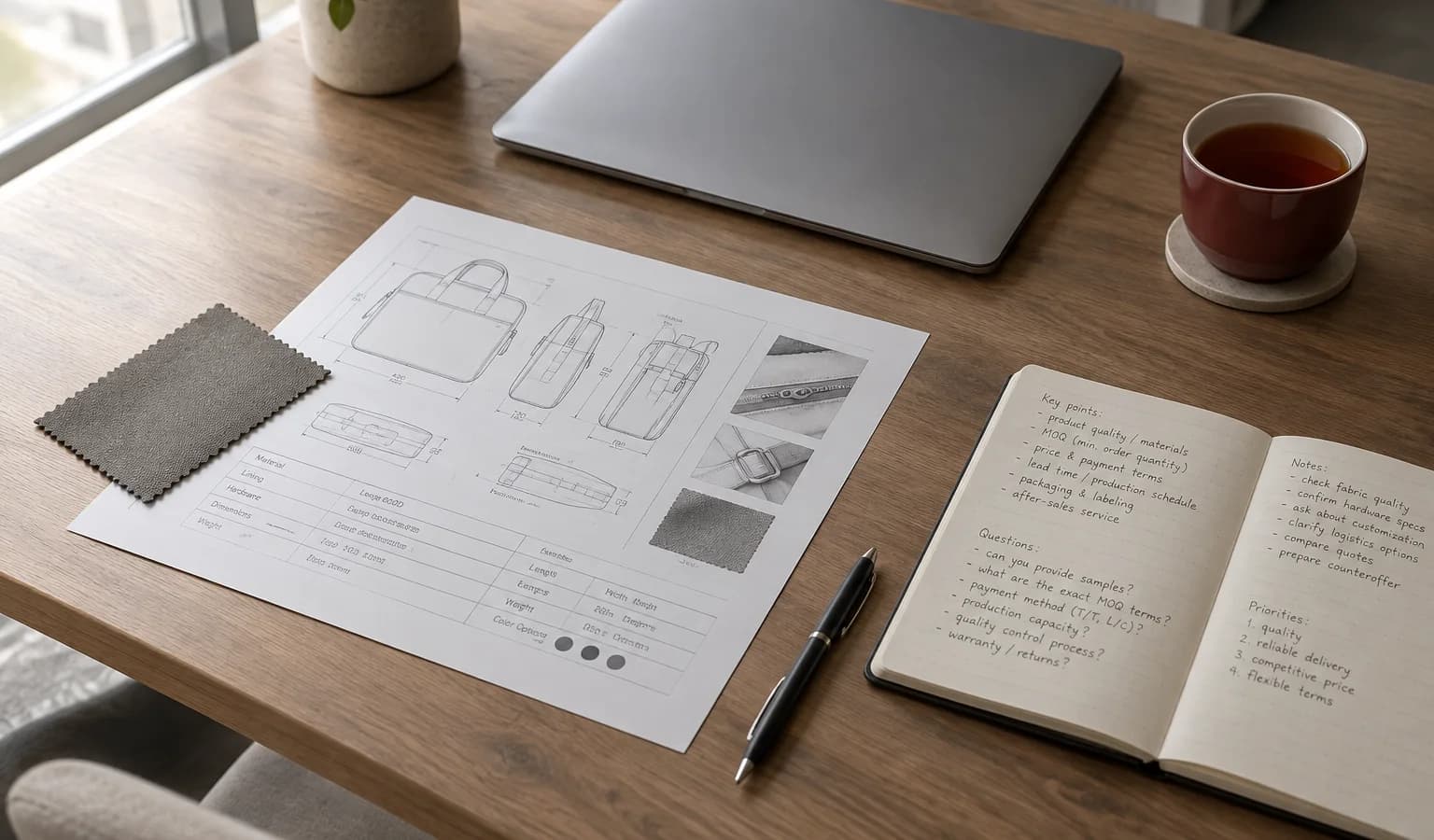
Preparation for negotiations with a Chinese supplier is usually misunderstood. It is imagined as picking phrases, haggling over price and finding the "right approach" to the Chinese. In reality, most of the outcome is determined before you write your first message. The Chinese side almost always enters the conversation better prepared than the buyer: it has a history of deals, an understanding of its own costs, knowledge of who makes decisions in the chain, and experience dealing with foreigners. The buyer often arrives with a general inquiry and the hope of "working things out as we go."
Below is a breakdown of the preparatory stage: what to decide, gather and check before contact. This is not an article about how to haggle, nor a guide to contracts, production audits or logistics — each of these stages has its own logic and its own materials.
What "preparing" means in the Chinese context
In the Western tradition, preparing for negotiations is first and foremost about gathering data: the market, prices, alternatives, BATNA. In the Chinese context, a second layer is added: understanding who on the other side actually makes the decisions and how the chain between you and that person is structured.
The Chinese export landscape is heterogeneous. Behind the "factory" sign there may be:
- a manufacturer with its own workshops and an export license;
- a manufacturer working through a foreign trade company (外贸公司, wàimào gōngsī) because it does not itself have the right to export;
- a trading agent or intermediary that produces nothing but knows the market well and takes a commission;
- the export department of a large holding, where the manager you correspond with has no influence on price at all.
The difference is fundamental. With a factory, you discuss cost, line utilization and MOQ. With an intermediary, you discuss its margin and how much it controls the manufacturer. With an export manager, you discuss only the parameters he is allowed to change. If you don't understand this, you prepare for negotiations with one type of counterparty and conduct them with another.
That is why preparation begins not with the question "what should I say" but with the question "who am I actually going to talk to."
Define your goal before contact: what you want and what you are willing to concede
The most common preparation mistake is entering the conversation with a single goal ("push the price down"). Price is only one of the parameters, and often not the main one. Before first contact, it helps to honestly answer a few questions for yourself.
What is critical for you and what is negotiable. Price, timelines, MOQ, payment terms, exclusivity, the right to samples, packaging, certification — all of these are variables. If you haven't decided in advance which ones you are willing to move on and which you are not, you will move on all of them under pressure.
What you can offer in return. A concession on price is almost always exchanged for something: volume, regularity, prepayment, giving up exclusivity, a long contract, handling logistics yourself. The Chinese supplier thinks of a deal as a balance, not as a one-sided concession. If you come only with a demand, the conversation quickly hits a polite "we'll think about it."
What your exit looks like. An alternative is not a threat but an internal reference point. If you don't know under what conditions you would stand up and leave, you won't be able to judge whether the offer in front of you is a good one.
It helps to write this down as a table: parameter, desired value, acceptable value, stop value. Such a document is not shown to the supplier, but it keeps you within bounds when the conversation drifts.
Gather a dossier on the supplier before first contact
Verifying a counterparty is not paranoia but a normal part of preparation. A minimum set of information is worth gathering in advance, because some of it you can only get from open sources, and some only by asking direct questions.
What is worth finding out:
- Legal entity. The exact company name, not a brand or a website name. In China, a company is identified by its full name and registration number (统一社会信用代码, tǒngyī shèhuì xìnyòng dàimǎ). Different spellings of the same name are common, and confusion here is costly.
- Production profile. What exactly the company claims as its own production and what it claims as purchased goods. It helps to cross-check the product range with what the company publishes on different platforms.
- Export experience. Whether the company works with your market, whether it has experience supplying to your country, whether it knows the certification and labeling requirements.
- History of contacts. Participation in exhibitions, presence on industry platforms, reviews from other buyers — all of this gives an indirect picture but requires careful interpretation.
It is worth noting separately: the exact procedures and timelines for verifying a Chinese legal entity through official registries depend on the specific registry and on whether you have access to it. I will not give specific timelines and procedures here — this is an area where it is better to rely on current information from the primary source rather than on generalizations.
The practical point of this stage is simple: the dossier determines which questions are even worth asking. If you already know that the company has its own production and export experience, you don't spend the first contact finding out basic things — you move on to the specification and terms.
Check who you are actually talking to
This is perhaps the most underrated item in preparation. A foreign buyer often corresponds with a person whose status in the company they have never clarified.
Typical roles on the Chinese side:
- 外贸业务员 (wàimào yèwùyuán) — foreign trade manager. Handles correspondence, prepares quotations, but usually has limited authority on price and terms.
- 外贸经理 (wàimào jīnglǐ) — head of the export department. Can make decisions within the agreed policy.
- 老板 (lǎobǎn) — the owner or de facto head. He is often the one who decides on price and exclusivity, but you have to reach him.
- Trading agent or intermediary. May present himself as a factory employee, although the factory is only one of his suppliers.
The direct question "are you a manufacturer or a trading agent?" at an early stage often yields an evasive answer. A more reliable path is to ask clarifying questions about production: where the workshop is located, how many lines there are, who is responsible for quality control, whether it is possible to visit the production site. The answers to these questions quickly reveal the real status of the person you're talking to.
Practical conclusion: don't start discussing price until you understand who is in front of you. Discussing price with someone who cannot change it is a waste of time and a cause of mutual irritation.
Prepare the specification so that it can be forwarded along the chain
Your inquiry is almost never read by one person. It passes through a manager, an engineer, a procurement officer, sometimes through several levels. That is why the specification must be self-contained: it must be understandable even if it is read without your explanations.
What helps:
- clear product parameters: material, dimensions, tolerances, color, coating, packaging;
- photos and, if possible, a sample or its description;
- references to standards, if applicable;
- marking and documentation requirements;
- volume and frequency of deliveries;
- desired timelines.
A specification in the form of a table with unambiguous wording reduces the risk that the factory will understand the task differently from you. It is not a guarantee, but it is preparation that saves weeks of correspondence.
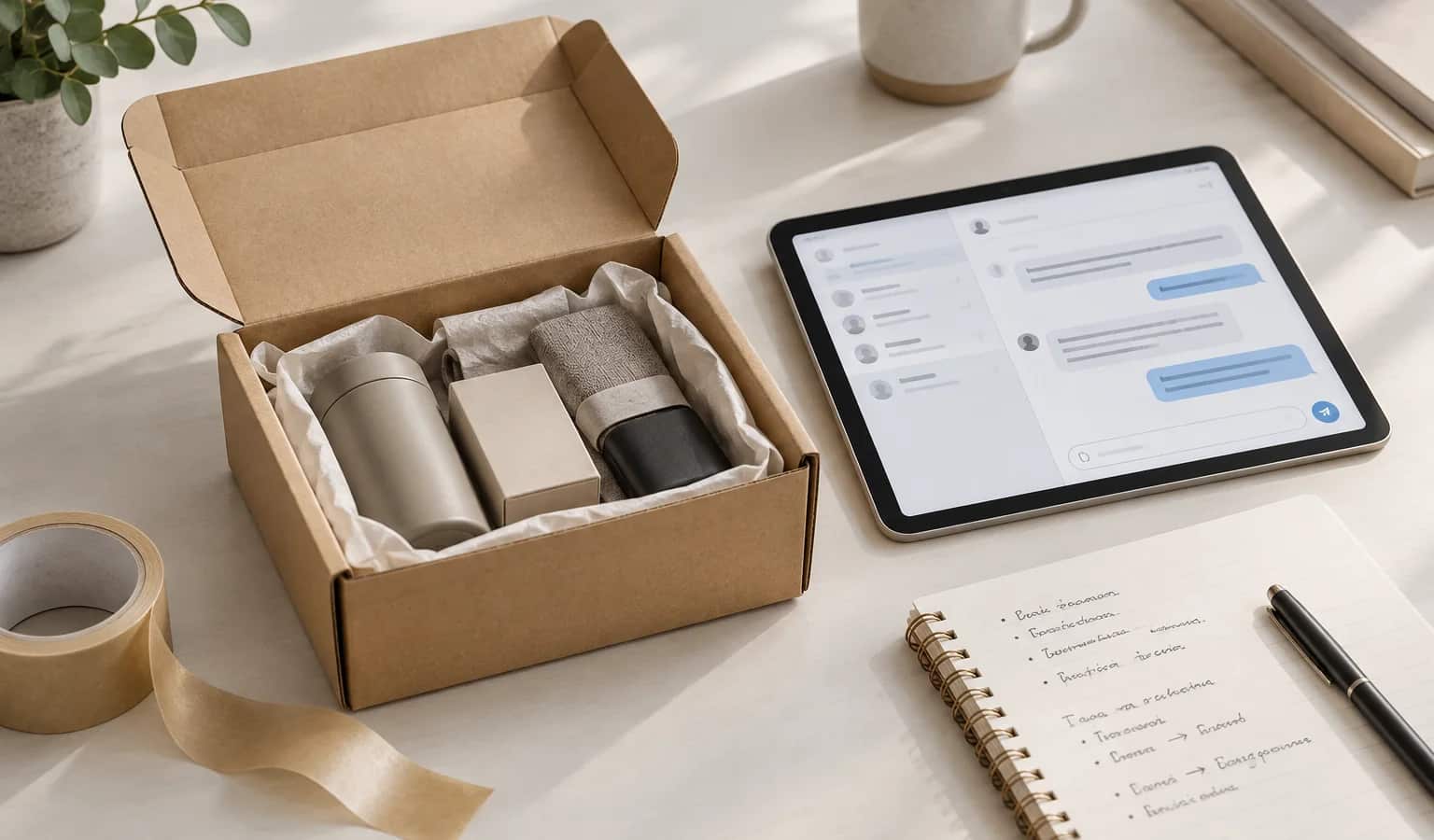
It is also worth formulating in advance the questions you want to ask the supplier. Not "tell us about your company" but specific ones: what is the minimum order, what are the payment terms, how do you control quality, what happens in case of defects, do you work with our market. A list of questions is part of preparation, not improvisation during the conversation.
Language preparation: written Chinese, English and the role of the interpreter
Language in negotiation preparation is not about fluency but about the division of functions.
English usually remains the language of negotiations, especially when it comes to price, terms and timelines. But English on the Chinese side is often limited to the level of the export manager. The engineer or workshop supervisor, on whom the technical part depends, may not speak it.
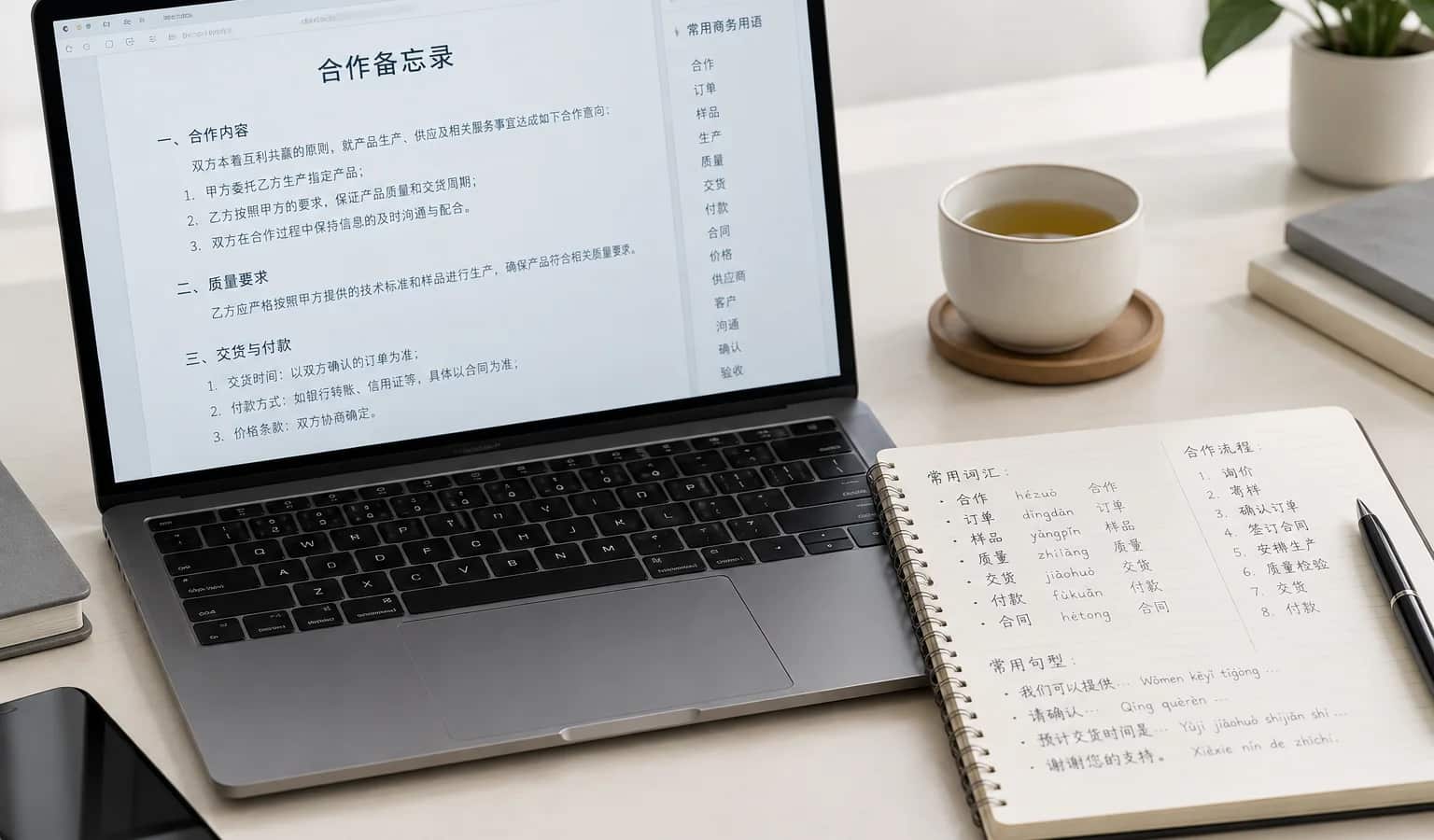
Written Chinese is useful for clarifications that must reach production without distortion. A short message with characters and pinyin often works more precisely than a long English sentence, especially when it comes to technical details.
Interpreter — not a luxury but a tool if you are discussing technical parameters or negotiating with people who do not speak English. It is important to understand: an interpreter conveys not only words but also tone. A good interpreter softens wording where directness may be perceived as pressure, and clarifies where the meaning slips away.
If you work with an interpreter, prepare a glossary of terms for him in advance. This noticeably improves accuracy.
Cultural settings: indirect refusal, face, the pace of first contact
This section is not about "Chinese specifics" but about how to read the signals you will receive in the conversation. These mechanisms are examined in detail in separate materials on the site; here is what matters specifically at the preparation stage.
Indirect refusal. In Chinese business communication, a direct "no" is often replaced by formulas like "this may be difficult," "we'll think about it," "we need to check with management." This is not necessarily evasion: a direct formulation may be perceived as a blow to the other person's face. For preparation, this means one thing: you must decide in advance which answers you consider a refusal and which an invitation to clarify. Otherwise you risk either taking politeness for agreement or seeing a refusal where there is none.
Face (面子, miànzi). This is public social credit that can be given, lost or preserved. At the preparation stage, it helps to think through how you will formulate questions so as not to put the other person in a position where he is forced to publicly admit a mistake or ignorance. The question "why can't you do it cheaper?" and the question "what factors determine your price?" lead to different answers.
The pace of first contact. The Chinese side often does not rush into specifics at the first stage. The first messages may be about getting acquainted, about the company, about what you do. This is not a waste of time but a stage at which an impression of you as a serious counterparty is formed. If from the first lines you demand the best price and a discount, you may get a formal answer and a polite cooling off.
The role of the intermediary. If there is an intermediary between you and the factory, he performs not only a logistical but also a communicative function: he translates, softens, sometimes filters. This can be useful, but it means that some information does not reach you. In preparation, it is worth deciding whether you are ready to work through an intermediary or want direct contact with production.
What to prepare on money and logistics
The money and logistics part is the area where preparation is especially visible. The exact terms are always a subject of negotiation, but basic reference points are worth having before contact.
Currency and payments. Chinese exporters usually work in US dollars, sometimes in yuan or euros. China's currency controls regulate the movement of funds, and this affects which payment schemes are possible. I will not give specific rules here — they change, and they should be checked against current sources.
Payment terms. A common practice in Chinese exports is prepayment, often partial, with the balance before shipment. The specific proportions depend on the industry, volume and history of the relationship. For preparation, it is important to decide what level of prepayment is acceptable to you and what guarantees you want to receive.
Incoterms. Delivery terms determine who bears the costs and risks at each stage. Chinese exporters often offer FOB, but this is not a universal rule. For preparation, it helps to understand in advance which option is advantageous for you and why.
Duties and certification. Your market's import requirements may be more significant than the supplier's terms. If you haven't found this out in advance, you may agree on a price that turns out to be unprofitable after all expenses.
Internal preparation: authority, limits, exit scenarios
This section is often skipped, yet it determines whether you can make a decision during the conversation at all.
Authority. If you conduct the negotiations yourself but cannot sign a contract without approval from management, this is worth understanding in advance. The Chinese side often perceives a lack of authority as a signal that you are not a serious counterparty. If you don't have the authority, it is better either to obtain it in advance or to honestly state who makes the final decision.
Limits. The upper price limit, the maximum volume, the minimum timeline — all of this must be determined before the conversation. During negotiations under pressure, it is easy to shift a boundary you haven't written down.
Exit scenarios. What do you do if the supplier does not agree to the terms? Look for another one? Change the specification? Postpone the deal? Having a scenario reduces anxiety and improves the quality of decisions.
Typical preparation mistakes
Below is what most often proves costly, and what can be fixed before contact.
- Starting with price. Price is a consequence of specification, volume, payment terms and the counterparty's status. If you start with price, you get a quotation with nothing to compare it to.
- Not finding out the status of the person you're talking to. Discussing terms with someone who doesn't make decisions is a waste of time.
- Sending a vague specification. The more assumptions it contains, the more likely the factory will understand the task differently.
- Ignoring cultural signals. A polite "we'll think about it" is not agreement. Direct pressure is not always the most effective path.
- Not having an alternative. Without an alternative, you accept terms that are unprofitable just to avoid losing the deal.
- Not checking your market's requirements. A price without accounting for duties and certification may turn out to be an illusion of a bargain.
- Negotiating without authority. This undermines trust and drags out the process.
Checklist before first contact
Below is a summary of what is worth having ready before the first message or call.
- The goal of the negotiations and a list of parameters: desired, acceptable, stop value.
- An understanding of what you can offer in return.
- Your alternative if the deal does not happen.
- A dossier on the supplier: legal entity, profile, export experience.
- An idea of who on the other side makes the decisions.
- A specification in the form of a table, understandable without explanations.
- A list of questions for the supplier.
- A decision on language: English, written Chinese, interpreter.
- Reference points on currency, payment terms, Incoterms.
- An understanding of your market's import requirements.
- Internal limits and authority.
- Exit scenarios.
Preparation does not guarantee that the negotiations will go smoothly. But it changes your position: instead of reacting to the Chinese side's proposals, you enter the conversation with your own framework. Chinese suppliers, as a rule, sense well who is in front of them — a buyer with a ready inquiry and clear boundaries or a buyer who hasn't yet decided what he wants. Preparation is what determines which category you fall into.
FAQ
Do you need to know Chinese to prepare for negotiations with a supplier?
Not necessarily, but it helps to understand how communication is structured. English is usually enough for negotiations about price and terms, if the export manager speaks it. Written Chinese helps with clarifications that must reach production without distortion. If you are discussing technical parameters or working with people who do not speak English, an interpreter becomes a tool rather than a luxury.
How can you tell whether you're dealing with a factory and not an intermediary?
A direct question often yields an evasive answer. It is more reliable to ask clarifying questions about production: where the workshop is located, how many lines there are, who is responsible for quality control, whether it is possible to visit the production site. The answers to these questions quickly reveal the real status of the person you're talking to. If the company cannot clearly describe its production process, it is probably an intermediary.
What should you do if the supplier answers "we'll think about it"?
This is not necessarily a refusal. In Chinese business communication, a direct "no" is often replaced by formulas that soften the refusal. "We'll think about it" may mean that the matter requires approval, that the offer is unprofitable, or that the person does not want to answer right now. It helps to ask a clarifying question: which specific parameters are causing difficulties, what needs to change for the offer to become workable. This shifts the conversation from the plane of agreement to the plane of terms.
Should you state your target price right away?
Usually not. Price is a consequence of specification, volume, payment terms and the counterparty's status. If you state your target price before these parameters are clarified, you give the supplier a reference point he will start from, and you lose the ability to compare offers. It is better first to obtain a quotation for a clearly described specification, and then discuss terms.
What documents should you prepare before first contact?
At a minimum — a specification with unambiguous parameters, a list of questions for the supplier and an internal document with your limits and exit scenarios. If you work with an interpreter, it helps to prepare a glossary of terms. The exact set of documents depends on the industry and on how complex the product you are purchasing is.