Asking a Chinese supplier for a discount often runs into a polite "the price is already the lowest." This isn't always a trick. In most cases the refusal has a specific reason — economic, organizational, or communicative — and understanding it matters more than finding a more insistent phrasing. If you know exactly where the limit lies, negotiations stop being pressure and become an exchange of terms.
Short answer
The price may not come down for four main reasons, and they often act simultaneously.
- The price is already close to cost, and a discount would mean working at a loss.
- The manager you're talking to simply doesn't have the authority to change the price.
- The discount is held back as a tool for a larger order, a long-term contract, or another client.
- A request for a discount without changing the deal terms reads not as a business request but as an attempt to simply take away margin.
None of these reasons means the supplier is inflexible in principle. It means the lever you're trying to push isn't connected to the mechanism you want to move.
What's behind the price: the cost structure at a Chinese factory
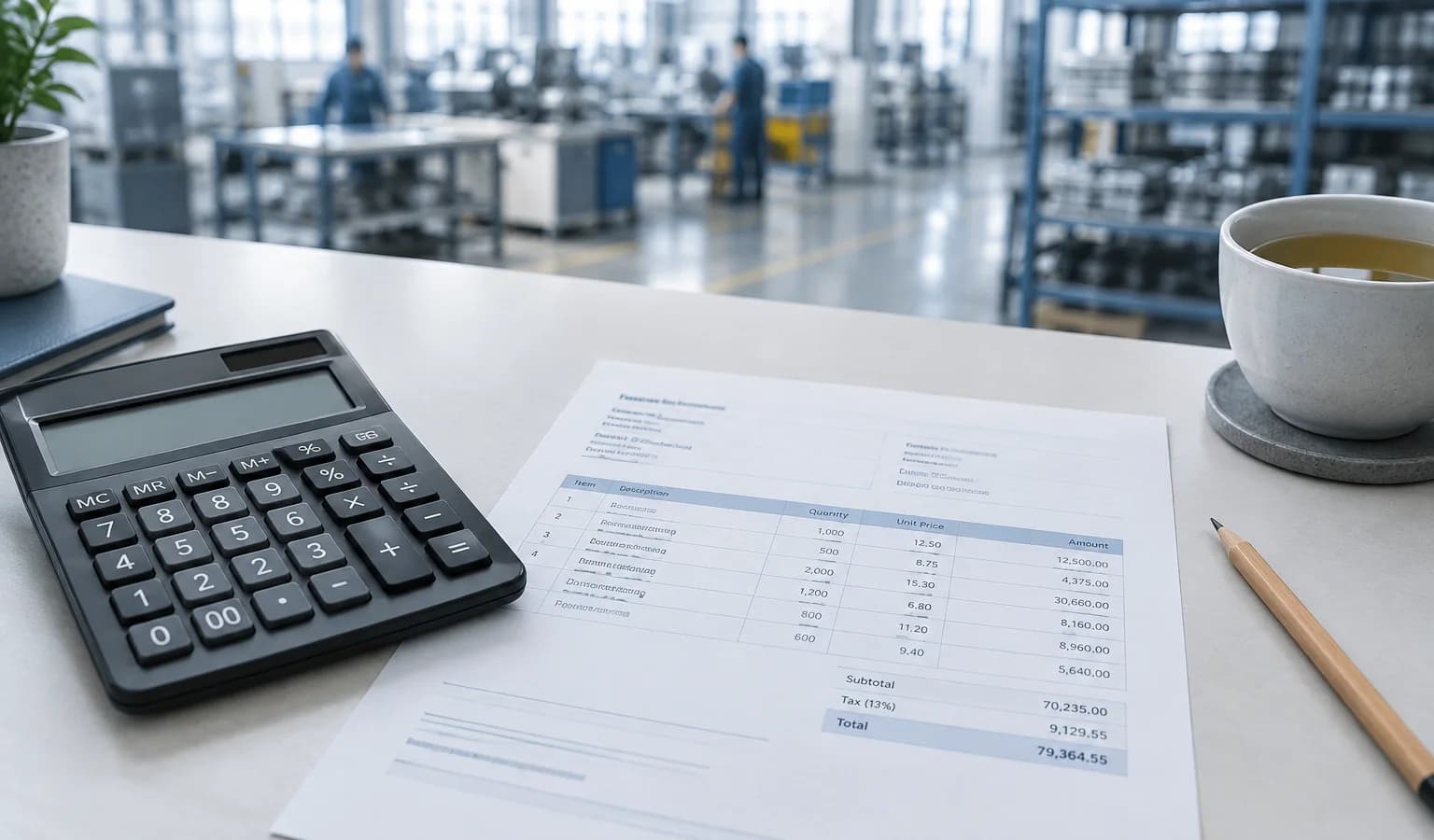
The price in a commercial quote isn't the owner's "appetite" but the sum of components. A typical production order includes:
- raw materials and materials;
- labor costs, including piece rates at assembly stations;
- electricity and water — especially significant for casting, heat treatment, textiles;
- packaging, including export crates;
- internal logistics and delivery to the port;
- tax payments and export VAT refunds;
- overhead: workshop rent, equipment, depreciation, management staff;
- the export company's commission, if you're not working with the factory directly.
In mass-market segments — tableware, simple hardware, basic textiles, packaging — the margin is often measured in single-digit percentages. This isn't the factory's poverty but a feature of the market: dozens of manufacturers with similar equipment stand nearby, and the price is determined not by greed but by competition. A discount of 5–10% in such a situation doesn't reduce profit — it turns the order into a loss. So the request "give us at least five percent" sounds to the supplier roughly like an offer to work for free.
There are also variable factors that change price flexibility at a given moment. Capacity utilization: if the factory is loaded at 90%, it has no reason to move on price. The yuan-to-dollar exchange rate: during sharp fluctuations, the supplier builds currency risk into the quote. Seasonality: before Chinese New Year and in peak shipping months, there's less free capacity. Raw material prices: rising costs of steel, aluminum, cotton, or polymers eat into the very margin you're asking to discount.
That's exactly why the same supplier may give a lower price in March than in November, without changing either its character or its attitude toward you.
Who decides on price: the manager, the department head, the owner
One of the most common mistakes is negotiating price with someone who has no right to change it. In a Chinese export company, the typical structure looks like this:
- Export manager (业务员, yèwùyuán) — handles correspondence, processes orders, coordinates samples and shipping. Their job is to retain the client and not lose the order. Price authority is usually zero or limited to a pre-set range.
- Sales manager (销售经理, xiāoshòu jīnglǐ) — can approve a discount within a few percent if they see justification: volume, repeat order, strategic importance of the client.
- Factory owner or general director (老板, lǎobǎn) — makes decisions about a price that affects cost. It's they who decide whether it's worth working with minimal margin for the sake of volume.
When you write to the manager "give me your best price," they may sincerely want to help you but simply have no ability to. At best, they'll pass the request upward. At worst, they'll respond with a polite refusal so as not to look to management like someone who hands out discounts left and right.
The practical takeaway is simple: if you want to discuss price, discuss it with the decision-maker. Sometimes it's enough to ask the manager to arrange a call with the supervisor — not as an ultimatum but as a clarification of terms. The phrasing "I need to understand what price options exist at different volumes" works better than "I need a discount."
Why haggling doesn't always work: cultural and business norms
In China, haggling is indeed widespread — but not uniformly. In markets, retail, and tourist areas, it's expected and even obligatory. In the B2B segment, the logic is different. Here the price is tied to specification, volume, timelines, and payment terms. A request to lower the price without changing at least one of these parameters is perceived not as negotiation but as an attempt to get more while giving nothing in return.
Add to this the concept of 面子 (miànzi) — "face," the social credit of trust that is measured publicly. A supplier doesn't want to look to management or colleagues like someone who easily gives up ground. Public pressure on price — especially in front of other buyers or in a group chat — can be perceived as a blow to face. This doesn't mean a discount is impossible; it means the way you ask for it affects the result.
Relationships (关系, guānxi) also play a role, but they don't override economics. A regular client who pays on time and doesn't create quality problems is more likely to get flexibility than a new buyer with a large but one-time order. However, even the best 关系 won't make a factory sell below cost. Relationships affect how you'll be refused and what you'll be offered in return, not whether the refusal will happen.
Another point is the difference between direct and indirect refusal. A Chinese supplier rarely says "no, there won't be a discount." More often they'll reply: "the price is already the most competitive," "we work with minimal margin," "let's discuss it at a larger volume." This isn't evasion but a way to preserve both your face and their own. If you take such phrasings literally, you might decide the supplier is just stalling. In fact, they're marking a boundary while leaving the door open for a different conversation.
Which levers actually affect the price
If a direct request for a discount doesn't work, changing the terms does. Here are the levers that actually move the price.
Volume and regularity
A one-time order of 1000 units and a contract for 12 000 units per year are different price categories. It's more profitable for a factory to load a line a year ahead, even with a lower margin per unit. If you can offer a purchase forecast or a framework agreement, that's a strong argument.
Specification and materials
Switching to a cheaper material, simplifying packaging, dropping branding, reducing the number of colors in a batch — all of this lowers cost and, accordingly, the price. Sometimes the supplier themselves suggests such an option instead of a discount, because for them it's an honest way to preserve margin.
Payment terms
Prepayment of 100% instead of 30% reduces the financial burden on the factory. It doesn't pay for financing production and can reflect this in the price. The same applies to shortening the deferred payment period.
Timelines and logistics
Flexibility on shipping dates, pickup from the factory warehouse, dropping rush production — all of this reduces costs and can be exchanged for price.
Long-term cooperation
If you're ready to discuss not one order but a series, the manager has grounds to request better terms from management. This isn't a guarantee, but it's a language the factory understands.
How to negotiate price: practical steps
Negotiating price isn't pressure but an exchange of information. Here's what helps.
- Ask for a price breakdown by component. Phrasing: "Can you show what makes up the price — materials, labor, packaging, delivery?" This doesn't guarantee a discount but shows where there's room for discussion.
- Clarify what's included in the price. Delivery, taxes, packaging, samples, mold cost — all of this can be a hidden part that can be optimized.
- Offer alternative terms instead of just asking for a discount. "If we increase the volume to X, what will the price be?" works better than "give me a discount."
- Ask about capacity utilization and timelines. If the factory is free, it has more motivation for flexibility. If it's loaded, less.
- Keep a respectful tone. Direct pressure, especially public, rarely yields results and can harm the relationship.
- Put agreements in writing. Verbal promises of a discount on the next order are easily forgotten. Written confirmation is already an obligation.
A separate note on comparing offers. Having gotten a price from one supplier, you shouldn't immediately use it as an argument in a conversation with another. It can work, but more often it's perceived as an attempt to play for a lower price without understanding the difference in quality, timelines, and reliability. It's more honest to compare not just the unit price but the total cost of ownership: sample costs, production timelines, defect risk, return terms.
When a discount is impossible: signs that the price is already minimal
There are situations when further attempts to lower the price are pointless. Here are the signs.
- The supplier refuses to discuss the price even with a significant increase in volume.
- Instead of lowering the price, they offer alternative materials or a simplified specification.
- They cite rising raw material prices or exchange rate fluctuations — and this is confirmed by the market situation.
- They're ready to give up the order rather than lower the price.
The last point is the most telling. If the supplier says "we can't work at that price," it's not a bluff. It means the price is below their cost, and they'd rather lose the order than work at a loss.
In such a situation, it's useful to ask yourself: what matters more to you — price or reliability? Sometimes a refusal to discount is a signal that the supplier is honest and isn't willing to cut corners on quality or timelines. That's not always bad.
What to do if the price still won't come down
If all the levers have been tried and the price won't budge, there are several options.
- Compare offers from other suppliers. But compare not just price, but quality, timelines, reliability, and how they work with samples.
- Consider alternative materials or a simplified design. Sometimes this yields more than direct haggling.
- Check whether the price is inflated because of an intermediary. If you're working through a trading company, it may be worth reaching the factory directly. But that's a separate topic, and it has its own risks.
- Assess the total cost of ownership. A cheap supplier with unstable quality can end up costing more than a slightly more expensive but reliable one.
- Make a decision. Sometimes a refusal to discount isn't a defeat but information: the price is fair, and further pressure only damages the relationship.
Ultimately, negotiating price isn't about who outplays whom. It's about finding terms under which both sides consider the deal profitable. If a supplier won't lower the price, maybe they're already at the limit. Or maybe they have a reason you don't yet see. Understanding that reason is the real task of negotiation.
FAQ
Why won't a Chinese supplier lower the price even if I'm ordering a large volume?
Perhaps the price is already minimal, or the manager doesn't have the authority, or the discount is reserved for a larger order. A large volume doesn't always mean low cost: if the factory is loaded, it doesn't need an additional order on unfavorable terms.
Should I insist on a discount?
Insistence without changing the deal terms can harm the relationship. It's better to offer an alternative: increased volume, a long-term contract, changed payment terms, or a simplified specification.
How do I know the price is fair?
Ask for a breakdown by component and compare with other offers. If the price is roughly the same across different suppliers, it most likely reflects real cost rather than greed.
Can I get a discount if I'm a new client?
Sometimes yes, but more often discounts go to regular clients or for large volumes. For a new client, a factory may offer a trial price but not a deep discount.
What should I do if the supplier won't make concessions?
Consider other suppliers or change the specification. If the price really is minimal and the quality and reliability are satisfactory, it may be worth accepting the terms and focusing on other aspects of the deal.